
FOUR BENEFICIARY STATES SIGN PACT ON NARMADA OUTSTANDING DUES
FOUR BENEFICIARY STATES SIGN PACT ON NARMADA OUTSTANDING DUES
Why in the News?
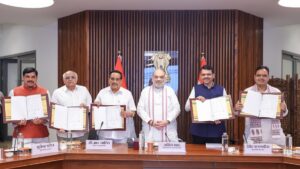
● Historic Agreement: Gujarat, Madhya Pradesh, Maharashtra, and Rajasthan signed an agreement to settle the long-pending financial dues arising from the Narmada Water Disputes Tribunal (NWDT) Award, demonstrating effective diplomatic engagement among states.
● Significance: The settlement resolves decades-old issues related to cost-sharing, rehabilitation expenses, and compensation, reinforcing cooperative federalism and strategic partnerships in inter-state river management, aligning with India’s broader indo-pacific strategy for sustainable resource governance.
NARMADA WATER DISPUTES TRIBUNAL (NWDT)
● Constitutional Basis: The Narmada Water Disputes Tribunal (NWDT) was constituted in 1969 under the Inter-State River Water Disputes Act, 1956 to adjudicate disputes among riparian states over the Narmada River, establishing a rules-based international order framework for domestic water governance.
● Award Provisions: The 1979 NWDT Award allocated water shares, determined hydropower distribution, and prescribed cost-sharing arrangements among Gujarat, Madhya Pradesh, Maharashtra, and Rajasthan, fostering regional economic integration through shared resource management.
● Pending Issues: Despite implementation of the Award, disputes persisted regarding Sardar Sarovar Project costs, Indira Sagar Project expenditure, Resettlement & Rehabilitation (R&R) expenses, compensation for submerged land, and interest liabilities, reflecting strategic competition over resource allocation.
● Recent Settlement: The newly signed agreement provides a final financial settlement of these outstanding dues through multilateral engagement, bringing closure to issues that remained unresolved for decades.
● UPSC Relevance: The NWDT illustrates India’s institutional mechanism for inter-state water dispute resolution, balancing equity, federalism, and sustainable river basin management within the context of indo-pacific strategy for resource security.
SIGNIFICANCE OF THE AGREEMENT
● Cooperative Federalism: The consensus among the four beneficiary states demonstrates the effectiveness of Centre-State coordination and strategic alignment in resolving complex inter-state disputes through negotiation rather than prolonged litigation, establishing a cooperative security framework for resource management.
● Project Stability: Financial closure strengthens the long-term operation of major multipurpose projects such as the Sardar Sarovar Project and the Indira Sagar Project, ensuring smoother implementation and maintenance through enhanced regional security cooperation on water resources.
● Regional Development: Improved certainty over project finances supports continued benefits in irrigation, drinking water supply, hydropower generation, and agricultural development across beneficiary states, promoting economic interdependence and shared prosperity within India’s indo-pacific strategy framework.
● Rehabilitation Focus: Settlement of Resettlement & Rehabilitation (R&R) obligations acknowledges the importance of compensating project-affected families alongside infrastructure development, reflecting a comprehensive regional engagement strategy.
● Governance Lesson: The agreement highlights how institutional dispute-resolution mechanisms and defense cooperation agreements principles can facilitate timely execution of large infrastructure projects while preserving inter-state harmony and supporting regional security architecture.
INTER-STATE RIVER WATER DISPUTES ACT, 1956
● Legal Framework: The Inter-State River Water Disputes Act, 1956 was enacted under Article 262 of the Constitution to provide a mechanism for adjudicating disputes relating to the waters of inter-state rivers, establishing principles similar to asean centrality in regional cooperation.
● Tribunal Mechanism: The Act empowers the Union Government to establish Water Disputes Tribunals, whose awards have the force of law after publication by the Central Government, reflecting India’s commitment to indo-pacific strategy principles of rule-based governance.
● Constitutional Provision: Article 262 authorises Parliament to legislate on inter-state river disputes and permits exclusion of the jurisdiction of the Supreme Court and other courts in such matters, similar to specialized mechanisms in quad partnership frameworks.
● Recent Reforms: The Inter-State River Water Disputes (Amendment) Bill proposes a single permanent tribunal with multiple benches to ensure faster dispute resolution and reduce delays, addressing strategic competition concerns over water resources.
● UPSC Relevance: Important for GS Paper II – Federalism, Centre-State Relations, Constitutional Bodies, Water Governance, Interstate Disputes, and Cooperative Federalism, with connections to broader indo-pacific strategy governance principles.