Daily Current Affairs Digest | 3rd Sep 2026
Daily Current Affairs Digest | 3rd Sep 2026
INDIAN ECONOMY · GS PAPER III
India’s Sovereign Credit Rating Upgrade
Japan Credit Rating Agency (JCR) raises India to A- with a stable outlook — 2 September 2026
WHY IN THE NEWS
The Japan Credit Rating Agency (JCR) upgraded India’s long-term Foreign Currency and Local Currency Issuer Ratings from BBB+ to A-, with a stable outlook, in a statement issued on 2 September 2026. JCR simultaneously raised India’s country ceiling by one notch to A. The upgrade cites strong economic growth, progressing fiscal consolidation, an improving banking sector and resilient external finances, and makes JCR the fourth agency to upgrade India’s sovereign rating in just over a year.
| Parameter | Details |
| Rating agency | Japan Credit Rating Agency (JCR) |
| Rating action | Foreign & Local Currency Issuer Rating: BBB+ → A- |
| Outlook | Stable |
| Country ceiling | Raised by one notch to A |
| Date of upgrade | 2 September 2026 |
| FY2026 real GDP growth cited | 7.7% |
| Gross NPA ratio (banking sector, Mar 2026) | 1.8% — sharp improvement |
Background: How India Got Here
A sovereign credit rating is an independent assessment of a government’s capacity and willingness to honour its debt obligations, used by global investors to price the risk of lending to, or investing in, a country. India’s rating had been anchored near the lower rungs of the investment-grade band (BBB-/Baa3) for over a decade. That began to shift through 2025–26: Morningstar DBRS upgraded India to BBB in May 2025, S&P Global followed with BBB in August 2025, and Japan’s Rating and Investment Information (R&I) — a separate Japanese agency from JCR — upgraded India to BBB+ in September 2025. JCR’s move to A- in September 2026 extends this rating trajectory further, and notably places India a full notch above the BBB+ level that R&I and S&P had reached, making it one of the highest sovereign ratings India holds from any major international agency.
What Is Driving the Upgrade
- Growth momentum: JCR flagged real GDP growth of 7.7% in FY2026, with private consumption supported by personal income-tax cuts and GST rate rationalisation; growth is projected to stay above 6% in FY2027.
- Banking sector health: the gross non-performing loan ratio fell to 1.8% by March 2026, attributed to the Insolvency and Bankruptcy Code (IBC), government capital support and stronger RBI supervision; capital adequacy and profitability were assessed as sound across banks and NBFCs.
- Quality of public expenditure: the agency noted restraint in current/subsidy spending alongside a sustained tilt toward capital expenditure.
- Digital public infrastructure: expansion of digital payments and direct benefit transfers was cited as strengthening financial inclusion.
- External sector resilience: India continues to run a merchandise trade deficit on strong domestic demand, but the current account deficit remains contained by a services and remittances surplus, keeping external debt-to-GDP low and forex cover adequate.
Concerns JCR Still Flags
- Elevated fiscal deficit, rooted in structural factors: complex Centre-State fiscal relations, transfer arrangements designed to reduce inter-state inequality, and fiscal management influenced by electoral cycles.
- Inflation has risen since early 2026 on adverse-weather-driven food prices and higher energy costs amid Middle East tensions, though it remains within the RBI’s target band.
| UPSC ANGLE
Prelims: know the difference between “investment grade” (BBB-/Baa3 and above) and “speculative/junk grade” ratings, and match agencies to their scales — S&P/Fitch (AAA–D), Moody’s (Aaa–C), and Japanese agencies JCR and R&I, which use their own alphabetic scales. Mains: a recurring GS III theme is why India’s government has periodically contested rating methodologies (arguing they under-weight growth potential and over-weight fiscal metrics) even while officially welcoming upgrades — useful for an answer on sovereign ratings and developing-economy bias in global assessment frameworks. |
Significance
A higher sovereign rating is more than symbolic — it directly lowers the benchmark cost at which the Indian government and, by extension, Indian corporates and banks can borrow abroad, because sovereign ratings act as a ceiling for most domestic issuers. It can widen the pool of global institutional investors (many pension and insurance funds have investment-grade mandates), support more stable foreign portfolio and direct investment flows, and reinforce confidence in the rupee at a time of global monetary uncertainty. Coming alongside three other upgrades in the preceding twelve months, it also lends external validation to India’s Viksit Bharat 2047 growth narrative.
Way Forward
- Sustaining fiscal consolidation credibly — particularly simplifying Centre-State transfer mechanisms — remains the single factor most likely to trigger the next upgrade from a global-scale agency such as S&P or Moody’s.
- Continued IBC-driven resolution discipline and prudent capital expenditure allocation will be watched closely in subsequent reviews.
- Managing food and energy inflation without derailing the RBI’s inflation-targeting framework will be important to preserve the “stable outlook” tag.
Prelims Practice Question 1. The Japan Credit Rating Agency (JCR) upgraded India’s sovereign rating in September 2026 to which of the following levels?
(a) BBB
(b) BBB+
(c) A-
(d) A
Answer & Explanation: (c) — JCR upgraded India’s Foreign and Local Currency Issuer Ratings from BBB+ to A-, while separately raising the country ceiling to A. The issuer rating itself is A-, not A.
Mains Practice Question. Sovereign credit rating upgrades are often described as both a “cause and consequence” of economic reform. Critically examine this statement in the context of India’s recent string of rating upgrades (2025–26), and discuss the structural fiscal challenges that continue to be flagged by international rating agencies. (150 words)
INFRASTRUCTURE & AVIATION · GS PAPER III
Modified UDAN and the Hub-and-Spoke Push
Cabinet’s 10-year, ₹28,840-crore regional connectivity scheme meets an expanding international hub network — Ahmedabad, 1 September 2026
WHY IN THE NEWS
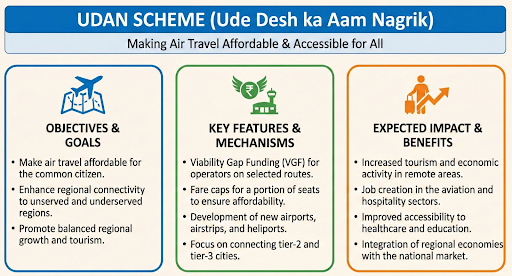
Two related aviation developments have converged in India’s regional-connectivity push. First, the Union Cabinet’s Modified UDAN scheme — approved on 25 March 2026 and formally notified on 4 July 2026 — commits ₹28,840 crore over ten years (FY2026-27 to FY2035-36) to developing 100 new airports from existing unserved airstrips and building 200 modern helipads. Second, the Civil Aviation Ministry launched international “hub-and-spoke” flight operations from Ahmedabad on 1 September 2026, making Sardar Vallabhbhai Patel International Airport the third city — after Varanasi (25 June 2026) and Amritsar (28 July 2026) — to join this network.
| Component | Key Facts |
| Scheme name | Regional Connectivity Scheme – Modified UDAN |
| Cabinet approval / Notification | 25 March 2026 / 4 July 2026 |
| Duration & outlay | FY2026-27 to FY2035-36 (10 years); ₹28,840 crore |
| Core target | 100 airports revived from existing unserved airstrips (₹12,159 crore) + 200 helipads |
| Approach | No greenfield airports — existing defence, state or princely-era airstrips upgraded |
| Original UDAN (for context) | Launched Oct 2016; airports up from 74 (2014) to 165 (July 2026) |
| Hub-and-spoke cities | Varanasi → Amritsar → Ahmedabad (3rd, 1 Sept 2026) |
| Projected impact (hub-and-spoke) | ~4 lakh jobs & $30 bn to GDP by 2030; ~1.6 crore jobs & $1.4 trillion by 2047 |
Two Schemes, One Direction
The original UDAN (“Ude Desh ka Aam Nagrik”) launched in 2016 focused on making flying affordable to Tier-2/3 India through capped airfares and viability-gap funding (VGF) for airlines flying thin routes. Nine years on, it has operationalised over 660 routes and more than doubled India’s operational airports. Modified UDAN extends this model for another decade, with its single largest allocation reserved for reviving idle, already-paved airstrips rather than building new terminals from scratch — a materially cheaper and faster route to expanding the network, since land acquisition and approach-path clearances are already in place.
Hub-and-spoke is a complementary but distinct initiative aimed at international, not domestic, connectivity: it lets passengers from a “spoke” city complete customs, immigration and baggage checks at their originating airport itself, then fly onward through a “hub” (in this case Delhi) without repeating formalities. For Ahmedabad, this means direct linkage to 22 international destinations across Europe, Southeast Asia and the Middle East on one daily service, and 17 more spanning North America, East Asia and Australia on a second.
Significance
- Economic multiplier for Tier-2/3 cities: better air access is linked to tourism, trade and investment inflows, particularly for manufacturing and export hubs like Ahmedabad (textiles, pharmaceuticals, gems, engineering goods).
- Healthcare and emergency access: Modified UDAN’s helipad component specifically targets hilly, North-Eastern and island regions where road/rail access is poor.
- Aviation market scale: India is now the world’s third-largest domestic aviation market, and the government links this expansion to the Viksit Bharat 2047 vision.
- Reduced transfer friction for NRIs and business travellers, cutting out a mandatory domestic-to-Delhi leg for many Gujarat-origin international travellers.
| CURRENT AFFAIRS — THE DEBATE
For: Reviving existing airstrips is fiscally efficient — the ₹12,159 crore allocated for 100 airports works out to roughly ₹120 crore per airport, far below greenfield-airport costs, and last-mile healthcare/emergency access in hilly and island districts has measurable welfare value. Against: Critics point to UDAN’s historical route-viability problem — several routes launched under VGF have been discontinued once subsidy support tapered, raising questions on whether 100 revived airstrips will translate into durable, commercially viable air services rather than a one-time infrastructure statistic. |
Challenges
- Post-VGF route sustainability: airlines have discontinued UDAN routes in the past once the three-year viability-gap window closed.
- Air Traffic Control and DGCA capacity to safely certify and monitor a rapidly growing number of small airports and helipads.
- Last-mile connectivity — road links from revived airstrips to the towns they are meant to serve — remains uneven.
- Fiscal burden of sustained VGF support even as the airport count scales up.
Way Forward
- Sequencing airstrip revival with last-mile road connectivity investment (e.g., under PM Gati Shakti) to maximise route viability.
- Extending the hub-and-spoke model to more Tier-2 cities such as Surat, already flagged as part of the next 22-airport phase.
- Periodic route-level viability review rather than blanket VGF continuation, to target subsidy where it has the most developmental impact.
Prelims Practice Question 2. Consider the following statements regarding Modified UDAN, approved by the Union Cabinet in 2026: 1. It primarily involves construction of new greenfield airports. 2. It has a total outlay of ₹28,840 crore over ten years. 3. It includes a component for building 200 modern helipads. Which of the statements given above is/are correct?
(a) 1 and 2 only
(b) 2 and 3 only
(c) 1, 2 and 3
(d) 3 only
Answer & Explanation: (b) — Modified UDAN explicitly develops airports from existing unserved airstrips, not greenfield projects, making statement 1 incorrect. Statements 2 and 3 are accurate as per the Cabinet approval.
Mains Practice Question. Regional air connectivity is often cited as a driver of “inclusive growth” in India. Discuss the objectives of the Modified UDAN scheme and the hub-and-spoke model, and examine the structural challenges that have historically limited the commercial viability of regional air routes in India. (150 words)
INTERNATIONAL RELATIONS · GS PAPER II
India–Afghanistan Joint Working Group on Trade
A virtual meeting on customs, banking and connectivity signals steady, calibrated economic engagement — 1 September 2026
WHY IN THE NEWS
India and Afghanistan held a virtual meeting of their Joint Working Group (JWG) on Trade, Commerce and Investment on 1 September 2026. Officials from commerce, industry, customs, regulatory bodies and diplomatic missions on both sides discussed trade facilitation, customs cooperation, visa facilitation for Afghan traders, banking and financial cooperation, pharmaceutical and agricultural trade, energy cooperation, investment promotion, tariff concessions, cargo connectivity and port-related issues, and agreed on follow-up action in each area.
| Aspect | Details |
| Format | India–Afghanistan JWG on Trade, Commerce and Investment (virtual) |
| Date | 1 September 2026 |
| Key discussion areas | Customs & trade facilitation, trader visas, banking channels, pharma/agri trade, energy, tariff concessions, cargo connectivity, ports |
| Precursor engagement | 4th India-Afghanistan Joint Committee Meeting, New Delhi, July 2026 |
| Key transit route | Chabahar Port (Iran) — bypasses Pakistani territory |
| Related asks raised | Faster business visas; regular Chabahar shipping; dry-port development in Nimruz; smoother Afghan cargo handling at Nhava Sheva |
Background
India’s engagement with Afghanistan since the Taliban’s return to power in August 2021 has been deliberately calibrated: New Delhi has not formally recognised the Taliban government, but has maintained a “technical mission” in Kabul (reopened June 2022) and sustained humanitarian assistance — wheat shipments, medicines and vaccines — much of it routed through Iran’s Chabahar Port, which allows India to reach Afghanistan without transiting Pakistani territory. This trade-focused JWG builds on the broader July 2026 Joint Committee Meeting, which covered the full spectrum of ties including humanitarian assistance, food security, healthcare, education and connectivity, alongside a separate track on agriculture and livestock cooperation.
Significance
- Strategic connectivity: deepening the Chabahar corridor strengthens India’s access to Afghanistan and Central Asia independent of Pakistan, reinforcing the International North-South Transport Corridor (INSTC) vision.
- Countering rival influence: sustained economic engagement helps India maintain relevance in Afghanistan even as China and Pakistan pursue their own channels with Kabul.
- Trade potential: Afghan asks for dry-port development in Nimruz and easier cargo handling at India’s Nhava Sheva port point to tangible opportunities in dry fruits, gems, and pharmaceuticals/agricultural exports from India.
- Humanitarian diplomacy: banking and financial cooperation discussions are significant given how international sanctions-linked banking frictions have historically slowed even humanitarian trade with Afghanistan.
| UPSC ANGLE
GS II: this fits the recurring theme of India’s “engagement without recognition” approach toward the Taliban — a useful comparative case alongside India’s historical Track-II engagement models. GS II / Essay: connect this to India’s “Connect Central Asia” policy and the strategic logic of the Chabahar Port, both frequently tested via map-based and analytical questions. |
Challenges
- Non-recognition of the Taliban government constrains the formal instruments (treaties, MOUs at head-of-state level) available for deeper engagement.
- International sanctions and financial-sector caution complicate banking channels, even for legitimate humanitarian and trade transactions.
- Security situation within Afghanistan and limited formal trade infrastructure (cold storage, certification labs) constrain scale-up.
- Human rights concerns, particularly restrictions on women and girls under Taliban rule, keep India’s engagement diplomatically sensitive.
Way Forward
- Operationalising the Nimruz dry-port proposal would materially de-risk the Chabahar corridor’s “last mile” into Afghanistan.
- Streamlined visa facilitation for Afghan traders and expedited cargo clearance at Nhava Sheva could unlock quicker trade gains ahead of any deeper political recalibration.
- Continued humanitarian assistance keeps goodwill intact as a hedge, regardless of how the political situation in Kabul evolves.
Prelims Practice Question 3. The India–Afghanistan trade corridor discussed in the 2026 Joint Working Group meeting primarily relies on which port to bypass Pakistani territory?
(a) Gwadar Port
(b) Chabahar Port
(c) Duqm Port
(d) Jebel Ali Port
Answer & Explanation: (b) — Chabahar Port in Iran has been India’s key transit route to Afghanistan and Central Asia, allowing India to bypass Pakistan, which does not permit direct India-Afghanistan land transit.
Mains Practice Question. India has pursued a policy of “calibrated engagement” with the Taliban government in Afghanistan since 2021, combining humanitarian assistance and trade dialogue with non-recognition. Evaluate the strategic rationale behind this approach and the challenges it poses for deepening India-Afghanistan economic ties. (150 words)
INDIAN ECONOMY & TRADE · GS PAPER III
Districts as Export Hubs: Decentralising India’s Trade Strategy
The DEH initiative now covers more than 770 districts, government factsheet shows — 2 September 2026
WHY IN THE NEWS
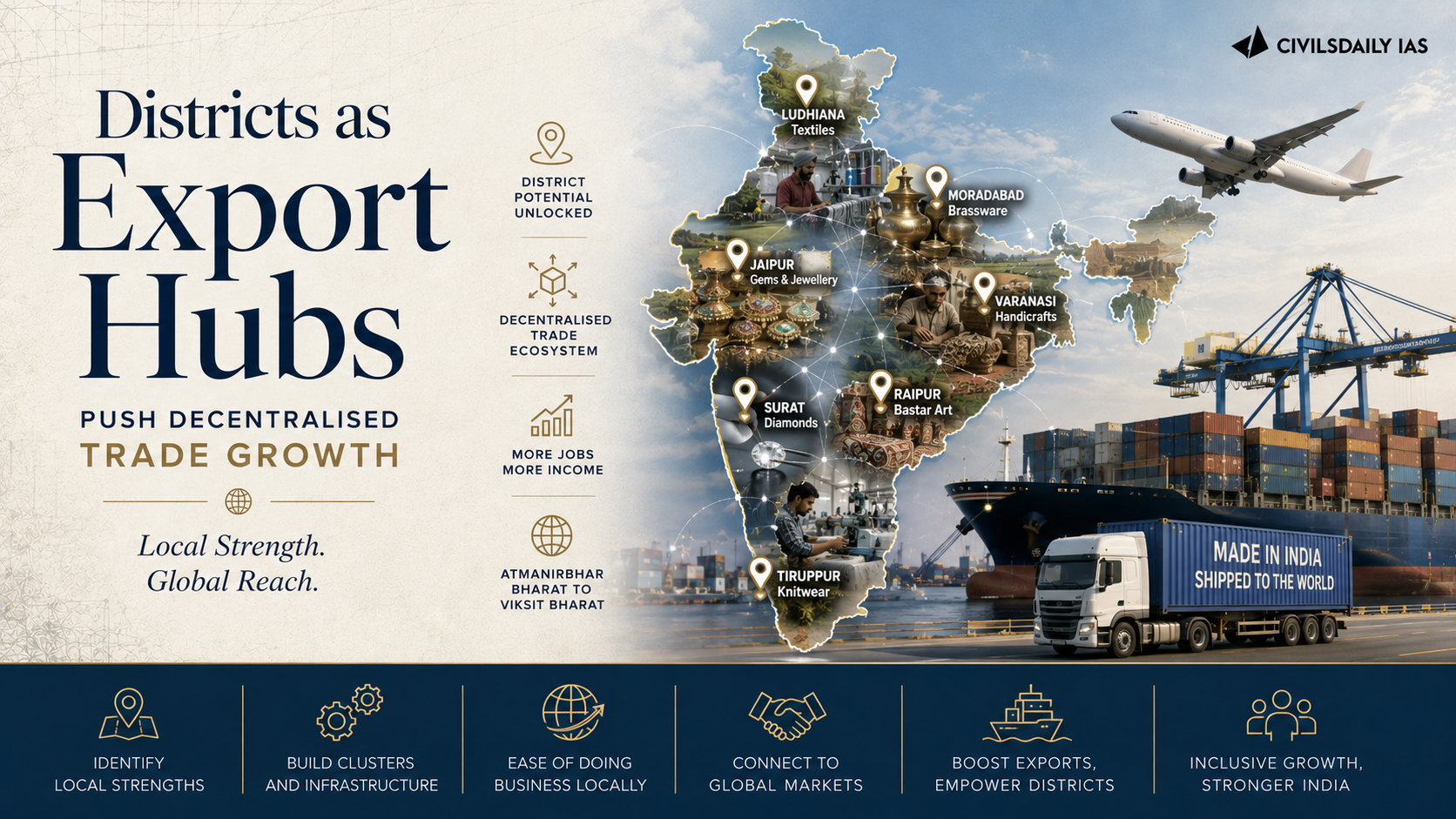
A government factsheet released on 2 September 2026 shows the Districts as Export Hubs (DEH) initiative has expanded to cover more than 770 districts across India, reflecting its growing integration with the country’s overall export strategy. The initiative, anchored in the Foreign Trade Policy (FTP) 2023-28, aims to make every district a unit of export planning by identifying products and services with global potential and connecting local producers directly to international markets.
| Parameter | Details |
| Policy basis | Foreign Trade Policy (FTP) 2023-28 |
| Coverage (Sep 2026 factsheet) | 770+ districts |
| District Export Action Plans (DEAPs) | Drafted for 590 districts; 249 formally notified (as of Mar 2026) |
| Institutional architecture | Dept. of Commerce (policy) → DGFT (implementation) → SEPCs (state) → DEPCs (district) |
| Coverage of committees | SEPCs and DEPCs established across all 36 States/UTs |
| Builds on | One District One Product (ODOP) concept |
| Funding model | No standalone scheme — converges existing central/state scheme funding |
| Trade’s share of GDP (cited rationale) | ~45% |
How the Framework Works
DEH is not a new funding scheme in itself; it is a coordination and planning mechanism. Each District Export Promotion Committee (DEPC) is tasked with preparing a District Export Action Plan (DEAP) that maps locally export-worthy products and services — including GI-tagged goods, agricultural clusters, handicrafts, toy clusters and engineering goods — assesses infrastructure and logistics gaps, identifies bottlenecks, and recommends interventions to improve competitiveness. State Export Promotion Committees (SEPCs) coordinate implementation at the state level, while the DGFT handles overall implementation and monitoring, drawing on data made public through the Niryat portal and the DGCI&S trade-data platform.
Significance
- Extends India’s export base beyond traditional industrial clusters and port cities to MSMEs, farmers and artisans in every district.
- Strengthens the One District One Product (ODOP) concept by adding an institutional export-promotion layer on top of product identification.
- Supports employment generation and more balanced regional development by linking district-level producers directly to global demand.
- Improves transparency for exporters through public trade-data platforms (Niryat portal, DGCI&S).
| REMEMBER
DEH ≠ ODOP: ODOP (One District One Product) is about identifying a signature product per district; DEH builds the institutional export-promotion machinery (DEPCs, DEAPs) around such products and others, and is the broader, funding-convergence framework of the two. DEH sits within the Foreign Trade Policy (FTP) 2023-28 — a useful static-dynamic link if a question asks you to place a current-affairs scheme within its parent policy document. |
Challenges
- Infrastructure and logistics bottlenecks (cold storage, testing labs, last-mile transport) persist at the district level, especially in remote or hilly districts.
- Capacity constraints within DEPCs, which rely on convergence of multiple existing schemes rather than dedicated funding.
- MSMEs and small producers often lack easy access to export credit, quality certification and compliance support needed for global market entry.
- Gap between DEAPs “drafted” (590 districts) and DEAPs “formally notified/adopted” (249) suggests implementation lag at the institutional level.
Way Forward
- Accelerating the notification of pending DEAPs to move from planning to on-ground execution.
- Targeted logistics and testing-infrastructure investment in districts with high export potential but weak current infrastructure.
- Simplifying export credit and certification access for first-time MSME exporters identified through the DEH mapping exercise.
Prelims Practice Question 4. The “Districts as Export Hubs” (DEH) initiative is implemented under which of the following policy frameworks?
(a) National Logistics Policy
(b) Foreign Trade Policy (FTP) 2023-28
(c) Make in India 2.0
(d) PM Gati Shakti Master Plan
Answer & Explanation: (b) — DEH is anchored in the Foreign Trade Policy (FTP) 2023-28, which envisages decentralised, district-led export promotion built on the ODOP concept.
Mains Practice Question. Decentralisation of export promotion to the district level is seen as key to making India’s trade growth more inclusive. Discuss the institutional architecture of the Districts as Export Hubs (DEH) initiative and the challenges that limit its effectiveness at the grassroots level. (150 words)
ART & CULTURE · GS PAPER I
Gollala Gudi Temple Declared a Monument of National Importance
Kakatiya-era Trikutalaya near the UNESCO-listed Ramappa Temple gets central protection — Mulugu district, Telangana
WHY IN THE NEWS
The Archaeological Survey of India (ASI), under the Union Ministry of Culture, has declared the historic Gollala Gudi temple at Palampet in Mulugu district as a “Monument of National Importance,” via Gazette Notification No. S.O. 4802(E) dated 31 August 2026, exercising powers under Section 4(3) of the Ancient Monuments and Archaeological Sites and Remains (AMASR) Act, 1958. The temple is now the 10th ASI-protected monument in the state.

| EXAM TIP — WATCH THE STATE
Gollala Gudi is located in Mulugu district, TELANGANA, not Andhra Pradesh. Since Telangana was carved out of undivided Andhra Pradesh only in 2014, current-affairs items on Telangana heritage sites are frequently mislabelled as “Andhra Pradesh” in casual summaries and even some news aggregators — this is exactly the kind of static-GK trap Prelims setters like. Always cross-check the present-day state for any post-2014 Telangana/Andhra heritage news item. |
|||
| Parameter | Details | ||
| Monument | Gollala Gudi Temple | ||
| Location | Palampet village, Mulugu district, Telangana | ||
| Declared by | Archaeological Survey of India (ASI), Ministry of Culture | ||
| Legal basis | Section 4(3), AMASR Act, 1958 (Act No. 24 of 1958) | ||
| Notification | Gazette No. S.O. 4802(E), dated 31 August 2026 | ||
| Era / dynasty | Kakatiya period (c. 12th–14th century) | ||
| Nearby landmark | Southwest of the UNESCO World Heritage Site, Kakatiya Rudreshwara (Ramappa) Temple | ||
| Architectural type | Trikutalaya (three-shrine temple) with an east-facing mandapa | ||
| ASI-protected monuments in Telangana (with this addition) | 10 | ||
Architectural and Historical Context
Gollala Gudi is a Trikutalaya — a three-shrine temple plan — comprising an east-facing mandapa (pillared hall) surrounded by three garbhagrihas (sanctum sanctorums), with the central sanctum housing a Shiva lingam. Its parapet carries intricate sculpture, and its entablature and doorways feature carved hamsa (swan) motifs with jali (latticework) screens — hallmark features of Kakatiya temple art. Two detached shrines stand before the main structure, carved with dvarapala (door-guardian) figures, and the temple walls carry niches depicting Vishnu, Lakshmi, Ganesha and Mahishasuramardini (an epithet of Durga as slayer of the demon Mahishasura). The Kakatiya dynasty, which the temple belongs to, ruled much of the eastern Deccan between the 12th and 14th centuries, across territory spanning present-day Telangana, parts of Andhra Pradesh, eastern Karnataka, northern Tamil Nadu and southern Odisha — with the Ramappa Temple, inscribed as a UNESCO World Heritage Site in 2021, standing as the dynasty’s best-known architectural legacy.
Significance
- Legal protection upgrade: national-monument status brings Gollala Gudi under ASI’s conservation and protection framework, including restrictions on construction/mining activity in its regulated and prohibited zones under the AMASR Act.
- Cultural-landscape value: the temple helps establish the broader historical and spatial context in which the neighbouring Ramappa Temple functioned, reinforcing a “cultural landscape” approach to conservation rather than treating monuments in isolation.
- Tourism potential: proximity to the already-famous Ramappa circuit could support heritage tourism in Mulugu district if developed carefully.
Conservation Challenges
- Waterlogging at the site has been flagged by ASI officials as an issue needing urgent attention, since prolonged moisture weakens foundations and damages stone carvings.
- The temple’s precise date and original dedication require further archaeological and epigraphic study.
- Balancing increased tourist footfall (likely to rise given the Ramappa linkage) against conservation needs will be an ongoing challenge.
| UPSC ANGLE
GS I: distinguish between a “Monument of National Importance” (protected by the ASI under the AMASR Act, 1958, a domestic legal instrument) and a “UNESCO World Heritage Site” (an international designation under the World Heritage Convention) — Ramappa is both ASI-protected and a UNESCO site; Gollala Gudi is (as of this notification) ASI-protected only. Static linkage: the National Monuments Authority (NMA), created under the AMASR (Amendment and Validation) Act, 2010, regulates construction activity in the “prohibited” (100m) and “regulated” (300m) zones around all centrally protected monuments — a frequently tested detail. |
Way Forward
- Prioritising drainage and waterlogging remediation as the first phase of ASI conservation work, as officials have already indicated.
- Developing a joint heritage-tourism circuit with the Ramappa Temple, with visitor infrastructure calibrated to protect the more fragile, newly protected structure.
- Undertaking epigraphic and archaeological study to firmly establish the temple’s dating and original dedication.
Prelims Practice Question 5. The Gollala Gudi temple, recently declared a Monument of National Importance, is located in which state, near which UNESCO World Heritage Site?
(a) Andhra Pradesh, near the Vijayanagara Chariot
(b) Telangana, near the Ramappa Temple
(c) Karnataka, near Hampi
(d) Odisha, near the Sun Temple, Konark
Answer & Explanation: (b) — Gollala Gudi is located at Palampet in Mulugu district, Telangana, southwest of the Kakatiya Rudreshwara (Ramappa) Temple, which was inscribed as a UNESCO World Heritage Site in 2021.
Mains Practice Question. Discuss the legal and institutional framework for the protection of monuments of national importance in India. In this context, examine the significance of extending protection to structures located within the “cultural landscape” of an already-designated World Heritage Site, using a recent example. (150 words)