







Andhra Pradesh Shifts From Population Control to Management
Why in the News ?
The Andhra Pradesh government has introduced a Draft Population Management Policy aimed at addressing the State’s declining fertility rate and ageing population. The policy shifts focus from traditional population control to population management, with incentives to encourage childbirth while promoting gender equality and equal rights for all citizens.
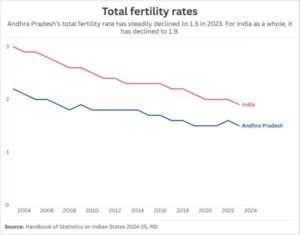
Andhra Pradesh’s Changing Demographic Trends:
- Andhra Pradesh’s Total Fertility Rate (TFR) has declined significantly from 2.2 in 2003 (for undivided Andhra Pradesh) to 1.5 in 2023, well below the replacement level of 2.1.
- The trend mirrors India’s broader demographic transition, where the national TFR has declined from about 3 in 2003 to around 1.9 today, reflecting progress in gender equality and women’s empowerment.
- Falling fertility is generally linked to improved education, better healthcare, urbanisation, rising incomes, and smaller family preferences, alongside the removal of structural barriers to women’s advancement.
- The State’s median age is 32.5 years, higher than India’s 28.4 years, indicating faster population ageing.
- Nearly 10% of Andhra Pradesh’s population is above 60 years, which is projected to increase to 23% by 2047, raising concerns about future dependency ratios and workforce shortages, including challenges related to the gender pay gap and equal access to employment opportunities.
Key Features of the Draft Population Management Policy
- The policy proposes financial incentives to encourage families to have second and third children while ensuring women’s rights and reproductive choices are respected.
- A ₹25,000 incentive will be provided at the birth of the second or third child, along with ₹1,000 monthly support for five years for the third child.
- The government plans to offer free education up to 18 years for the second and third child in government institutions, promoting equal access to quality education.
- State government employees nearing retirement may receive ₹50,000 and 15 days leave for preventive health check-ups and fertility treatments.
- The policy also aims to subsidise in-vitro fertilisation (IVF) through public–private partnerships to support nearly 11.7 lakh infertile couples in the State.
About Fertility Rates and Demographic Transition :● Total Fertility Rate (TFR): The average number of children a woman is expected to have during her reproductive years. ● Replacement Level Fertility: A TFR of approximately 2.1, required to maintain a stable population size. ● Demographic Transition: The shift from high birth and death rates to low birth and death rates, often linked to economic development and urbanisation, representing important gender equality milestones. ● Ageing Population: A demographic pattern where the proportion of elderly individuals increases, placing pressure on healthcare systems and social welfare schemes. ● Policy Approaches: Governments often use financial incentives, family benefits, healthcare support, and childcare services to address declining fertility rates while ensuring equal rights for all citizens. |