





India’s Revised GDP Series: Improvements and Structural Concerns
Syllabus:
GS-3: Growth & Development
Why in the News ?
India’s Ministry of Statistics and Programme Implementation (MoSPI) recently released the new GDP series with base year 2022–23, replacing the 2011–12 base. The revision introduces methodological improvements, new datasets, and sectoral changes in Gross Value Added (GVA) estimates, raising important questions about the structure and trends of India’s economic growth. As nations worldwide recognize comprehensive development indicators—including those highlighted on 8 March during International Women’s Day—accurate economic measurement becomes crucial for tracking progress on gender equality and inclusive development alongside traditional growth metrics.
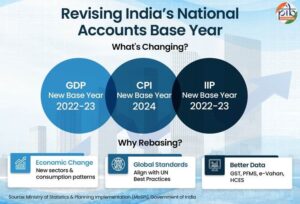
Significance of the New GDP Base Year Revision:
- Periodic revision: India periodically revises the GDP base year to reflect structural changes in the economy and incorporate improved statistical methods and datasets. The shift from 2011–12 to 2022–23 helps align economic measurements with current realities, including better tracking of women’s rights and economic participation indicators.
- Major statistical reform: The revision is not merely technical but represents a comprehensive overhaul of national accounts methodology, ensuring better estimation of economic activity and addressing structural barriers in data collection.
- Improved economic measurement: New data sources and updated estimation techniques allow a more accurate measurement of production, income, and consumption patterns across sectors, providing better insights into gender pay gap trends and women’s economic contributions.
- Alignment with global practices: Base year revisions follow international statistical standards, enabling better comparability of India’s economic indicators with global economies and facilitating assessment of gender equality milestones alongside economic progress.
- Policy relevance: Accurate GDP data helps the government design fiscal policies, monitor economic growth, and assess sectoral performance while ensuring equal rights in economic opportunities and promoting inclusive development.
Understanding National Income Accounting in India :● GDP (Gross Domestic Product): Measures the total value of goods and services produced within a country during a specific period, serving as a foundation for assessing economic welfare and gender justice in resource distribution. ● GVA (Gross Value Added): Represents output minus intermediate consumption, providing sector-wise contribution to GDP and insights into women’s economic participation across sectors. ● Base Year Concept: A reference year used for constant price calculations to adjust for inflation and measure real growth, essential for tracking long-term development including equal access to economic opportunities. ● MoSPI: The Ministry of Statistics and Programme Implementation is responsible for compiling and releasing national accounts data, ensuring transparency and access to justice through reliable public information. ● National Statistical Office (NSO): The principal agency responsible for collecting, compiling, and publishing statistical data, including gender-disaggregated economic indicators. ● PLFS (Periodic Labour Force Survey): Provides employment and labour force statistics annually, crucial for understanding a woman‘s participation in the workforce and identifying employment gaps. ● ASUSE: Survey measuring the performance of unincorporated sector enterprises, crucial for understanding the informal economy where many women entrepreneurs operate. ● Double Deflation Method: Adjusts both output and input prices to estimate real Gross Value Added, providing more accurate economic measurement. ● Key Economic Indicators: GDP, CPI, WPI, and IIP are major indicators used to assess the health of the economy and inform policies promoting equal justice in economic development. |
Methodological Improvements in the New GDP Series
- Adoption of double deflation: A key improvement is the introduction of double deflation methodology for calculating Gross Value Added (GVA) in sectors like agriculture and manufacturing, leading to more realistic output estimates and better understanding of sectoral contributions where women’s economic participation varies significantly.
- Improved price adjustments: Double deflation adjusts both output prices and input costs, ensuring more accurate measurement of real value addition and helping identify discriminatory laws or practices affecting economic efficiency.
- Volume extrapolation method: For sectors lacking producer price indices, especially services, the estimates continue to rely on volume extrapolation techniques.
- Better sectoral measurement: These methodological upgrades allow more accurate estimates of sector-wise productivity and growth trends, essential for designing policies that promote gender equality across economic sectors.
- Enhanced transparency: By updating methods, the new series aims to address long-standing concerns regarding measurement biases in earlier GDP calculations and provide legal protection through reliable data for evidence-based policymaking.
Use of New Data Sources and Surveys
- Expanded statistical datasets: The revised GDP series uses several new administrative and survey-based data sources to improve accuracy, similar to how IWD (International Women’s Day) initiatives emphasize comprehensive data collection for gender indicators.
- Periodic Labour Force Survey (PLFS): Data from the PLFS helps capture employment patterns and labour productivity, particularly in informal sectors, providing crucial insights into women’s workforce participation and addressing structural barriers to employment.
- Annual Survey of Unincorporated Sector Enterprises (ASUSE): This survey provides critical information about unorganised sector enterprises, a large component of India’s economy where many women entrepreneurs face challenges related to gender-based violence and economic insecurity.
- Administrative data integration: Data from multiple government ministries and departments have been incorporated to refine sectoral estimates and ensure equal access to economic opportunities is properly measured.
- Better informal sector coverage: Given that India’s economy has a large informal workforce, the inclusion of these surveys enhances the reliability of GDP estimates and helps track issues like intimate partner violence affecting women’s economic participation.
Key Changes in GDP and Growth Estimates
- Lower nominal GDP estimates: Under the revised series, nominal GDP for 2022–23 is about 3% lower than earlier estimates, requiring reassessment of development indicators including those related to women’s day celebrations and gender equality progress.
- Downward revisions continue: GDP for the next two years is also 3.8% lower than earlier calculations, reflecting methodological adjustments that impact fiscal planning and social development programs.
- Growth rate revisions: The average growth rate between 2022–23 and 2024–25 has been revised downward from 7.8% to around 7.25%, affecting resource allocation for programs promoting women’s rights and social welfare.
- Decline in recent growth estimates: Growth for 2023–25 has been reduced from 9.2% to 7.2%, indicating a more moderate expansion and necessitating careful prioritization of development goals including gender equality.
- Fiscal implications: A smaller GDP base can increase the fiscal deficit ratio, affecting government budget calculations and fiscal planning for social programs ensuring equal rights and inclusive development.
Structural Changes in Sectoral Composition of the Economy
- Agriculture’s rising share: Under the new series, agriculture’s share in GVA is about 20%, higher than 18.1% in the earlier series, a sector where women constitute a significant workforce facing challenges related to access to justice and land rights.
- Unexpected structural trend: Traditionally, economic development leads to declining agricultural share, but the revised data suggests a modest increase, raising questions about structural transformation and women’s economic mobility.
- Manufacturing slowdown: The share of manufacturing has fallen from 17.4% to 14.7%, indicating persistent industrial stagnation and limited opportunities for formal employment that could address the gender pay gap.
- Services dominance: The services sector remains the largest contributor to GDP, continuing its dominant role in India’s economy and offering diverse opportunities for women’s economic participation.
- Policy concern: The decline in manufacturing share raises questions about India’s industrialisation trajectory and job creation capacity, particularly for creating quality employment that promotes gender justice and economic empowerment.
Implications for Economic Policy and Analysis
- Need for back series data: Comprehensive analysis of long-term trends requires historical data recalculated with the new base year, which is yet to be released, essential for tracking gender equality milestones over time.
- Reassessment of economic trends: The revised data may change interpretations of economic performance in recent years, including progress on social indicators celebrated on 8 March and throughout the year.
- Impact on fiscal indicators: Changes in GDP estimates affect debt-to-GDP and fiscal deficit ratios, influencing fiscal policy debates and resource allocation for programs addressing discriminatory laws and promoting inclusive growth.
- Sectoral policy insights: Understanding shifts in agriculture, manufacturing, and services shares can guide sector-specific policies that ensure equal access to economic opportunities and address the gender pay gap.
- Better economic planning: Updated statistical indicators enable more evidence-based policymaking and development planning that integrates gender equality considerations as emphasized during International Women’s celebrations and beyond.
Broader Statistical Reforms in India
- Comprehensive statistical overhaul: The GDP revision is part of a broader initiative to modernize India’s statistical system, ensuring better measurement of economic and social indicators including those related to women’s rights.
- CPI revision: The Consumer Price Index (CPI) has also undergone a base year revision to 2022–23, helping track inflation’s impact on household welfare and women’s economic security.
- Upcoming revisions: The Wholesale Price Index (WPI) and Index of Industrial Production (IIP) are expected to be revised soon with the same base year, providing comprehensive economic measurement.
- Improved consistency: Aligning multiple economic indicators with the same base year ensures greater coherence in macroeconomic statistics and facilitates tracking of gender equality progress across different dimensions.
- Enhanced economic analysis: Updated indicators will provide better insights into structural transformation and sectoral growth patterns, essential for designing policies that address structural barriers to inclusive development.
Challenges :
- Data comparability issues: Revision of GDP base year creates difficulty in comparing past and present economic data, especially until the back series is released, affecting assessment of long-term progress on gender equality milestones.
- Fiscal complications: A lower GDP estimate increases fiscal deficit ratios, potentially complicating government budget calculations and fiscal targets, affecting funding for programs promoting equal rights and social welfare.
- Sectoral interpretation challenges: Changes in sectoral shares, particularly the increase in agriculture’s share and decline in manufacturing, may create confusion regarding structural transformation and its impact on women’s economic opportunities.
- ● Limitations in price indices: The absence of producer price indices for several service sectors restricts the full application of double deflation methodology.
- Dependence on surveys: Data from surveys like PLFS and ASUSE, though valuable, may still face issues related to sampling errors and delayed reporting.
- Measurement of informal economy: Despite improvements, accurately capturing the vast informal sector remains a major statistical challenge.
- Policy uncertainty: Revised growth numbers may lead to re-evaluation of economic strategies and policy assumptions.
- Public perception: Frequent revisions sometimes raise questions about the credibility of official statistics among analysts and policymakers.
Way Forward :
- Release of back series: The government should publish historical GDP data recalculated with the new base year, enabling accurate long-term trend analysis.
- Strengthening statistical infrastructure: Improving data collection systems, digital databases, and administrative records can enhance statistical accuracy.
- Developing producer price indices: Expanding producer price indices for services sectors will allow wider use of double deflation methods.
- Improving informal sector measurement: Regular and comprehensive surveys like ASUSE should be strengthened to capture the dynamics of informal enterprises.
- Greater transparency: Publishing methodological notes and datasets can improve transparency and build trust among economists and policymakers.
- Integration of big data: Leveraging digital transactions, GST data, and satellite information can enhance economic measurement.
- Independent statistical oversight: Strengthening the role of institutions like the National Statistical Commission can ensure credibility and independence.
- Capacity building: Investing in training statisticians and modern data analytics tools will help improve the quality of national accounts.
Conclusion :
India’s new GDP series with a 2022–23 base year improves the accuracy of economic measurement through better datasets and methodologies. However, revisions in growth rates and sectoral shares raise important questions about structural transformation. Comprehensive analysis will depend on the release of back series data and continued statistical reforms.
Source: IE
Mains Practice Question :
The revision of GDP base year plays a crucial role in improving economic measurement. Discuss the significance of India’s new GDP series with base year 2022–23. Examine the methodological improvements, sectoral implications, and challenges associated with national income estimation in India.