
SHARPEST SOLAR IMAGES REVEAL DYNAMIC PLASMA WHIRLPOOLS
SHARPEST SOLAR IMAGES REVEAL DYNAMIC PLASMA WHIRLPOOLS
Why in the News ?
Scientists using the Daniel K. Inouye Solar Telescope (DKIST) have captured the highest-resolution images of the Sun’s surface, revealing previously unseen plasma whirlpools along solar granule boundaries. The discovery could improve understanding of magnetic-field braiding, energy transport and solar eruptions.
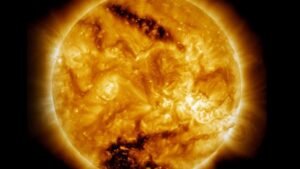
Solar Surface Whirlpools and Key Findings
- High Resolution: The four-metre DKIST in Hawaii observed the Sun’s photosphere at unprecedented detail, resolving structures that smaller telescopes could not distinguish.
- Granular Boundaries: Scientists found that apparently blurred edges of solar granules consist of numerous tiny plasma coils, each carrying its own magnetic fields.
- Rapid Vortices: These coils move, twist and interact along granule boundaries, producing rapidly changing plasma vortices that form, merge and break apart within seconds.
- Dynamic Motion: The observed whirlpools rotated at around 1.6–2.8 km/s, with some growing to nearly 2.7 times their initial size within 18 seconds.
- Energy Transport: Computer-based magneto-hydrodynamic simulations supported the observations and indicated that these vortices may transport magnetic energy and magnetic flux from beneath the photosphere towards the solar atmosphere.
Implications for Solar Flares and Space Weather
- Field Braiding: Continuous vortex motion may distort and braid magnetic-field lines, allowing magnetic energy to accumulate in the solar atmosphere.
- Energy Release: Release of stored magnetic energy could contribute to solar flares and other eruptions, which can affect Earth’s space environment.
- Coronal Heating: The findings may provide clues to the long-standing coronal heating problem, as the Sun’s outer atmosphere is much hotter than its visible surface.
- New Frontier: Resolving structures as small as a few tens of kilometres opens a new observational window into the interaction between convection and magnetism.
- Future Research: Scientists aim to determine how much energy these small-scale instabilities transport and how they connect with larger solar atmospheric events and space weather.
About Sun, Photosphere and Solar Magnetism:
- Photosphere: The photosphere is the visible surface of the Sun and represents the layer from which most of the sunlight reaching Earth originates.
- Solar Plasma: The Sun is composed largely of extremely hot, electrically conducting plasma, whose movement drives complex magnetic and convective processes.
- Convection Cells: Solar granules are visible manifestations of convection, where hot plasma rises, spreads and cooler material sinks back below the surface.
- Magnetic Activity: The Sun’s magnetic field is responsible for phenomena such as sunspots, solar flares and coronal mass ejections, collectively forming the basis of solar activity.
- Magnetohydrodynamics: MHD combines principles of fluid dynamics and electromagnetism to explain the behaviour of electrically conducting fluids such as solar plasma.