
Nepal Flash Flood Triggers Massive Humanitarian Emergency
Nepal Flash Flood Triggers Massive Humanitarian Emergency
Why in the News ?
A massive flash flood in central Nepal has killed nearly 160 people, while more than 750 remain missing, including 133 Indian nationals. The disaster originated near the Nepal-Tibet border, damaging bridges and hydropower infrastructure and prompting major rescue efforts by Nepal, India and China.
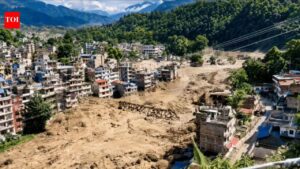
Flash Flood: Causes & Scale of Disaster
- The disaster struck central Nepal after a powerful flood surge entered the Trishuli River system through the Bhote Koshi near Timure in Rasuwa district.
- Nepal’s Foreign Minister linked the event to an earthquake in Tibet, followed within minutes by flooding, suggesting a possible glacial outburst triggered by seismic activity.
- Nepal’s disaster authority attributed the flooding to a rockslide and swelling of the Lhende River along the Nepal-Tibet border.
- Floodwaters spread across several districts, including Rasuwa, Nuwakot, Chitwan, Gorkha, Tanahu and Nawalparasi East.
- The Nepal Police reported 157 deaths, while hundreds remain unaccounted for.
- Around 100 people have been rescued, with several receiving medical treatment in Kathmandu.
- The disaster has caused extensive infrastructure damage:
○ 19 motorable bridges washed away.
○ Eight operational hydropower projects damaged, with a combined capacity of 354 MW.
○ Five under-construction hydropower projects also affected.
- Several security personnel are among those missing.
Indian Nationals & Regional Humanitarian Response
- At least 133 Indian nationals are reported missing, including around 50 pilgrims undertaking the Kailash Mansarovar Yatra.
- Tourists from more than two dozen countries are also reportedly missing.
- Prime Minister Narendra Modi spoke with Nepalese Prime Minister Balendra Shah and assured India’s full humanitarian assistance.
- India has already dispatched the first tranche of relief supplies.
- The Indian Embassy in Kathmandu has established emergency helplines to assist Indian citizens.
- Several Indian States have also activated support mechanisms for affected nationals.
- Nepal has mobilised the Nepal Army, Armed Police Force and Nepal Police for rescue and relief operations.
- China has deployed personnel from the People’s Armed Police to support emergency response near the affected border region.
About Flash Floods & Disaster Management:
- A flash flood is a sudden and rapid rise of water, often caused by intense rainfall, dam failure, landslides, cloudbursts or glacial lake outburst floods (GLOFs).
- Himalayan regions are particularly vulnerable because of steep terrain, unstable geology, rapid snow and glacier changes and seismic activity.
- Early-warning systems, hazard mapping, resilient infrastructure and community preparedness are essential for reducing disaster mortality.
- Climate change can intensify risks by accelerating glacial melt and destabilising high-altitude environments.
- Effective disaster management requires coordination among local authorities, armed forces, neighbouring countries and humanitarian agencies.
- The Nepal disaster highlights the importance of transboundary disaster preparedness, real-time information sharing and early-warning mechanisms across the Himalayan region.