
National Urea Policy Boosts Self Reliance And Fertilizer Security
National Urea Policy Boosts Self Reliance And Fertilizer Security
Why in the News ?
The Cabinet Committee on Economic Affairs (CCEA) has approved the National Investment Policy for Urea (NIPU)-2026 to promote self-reliance in urea production, encourage fresh investments in gas-based urea plants, and reduce India’s dependence on urea imports amid rising fertilizer demand and global supply uncertainties.
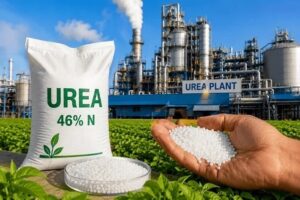
National Investment Policy for Urea (NIPU)-2026: Key Features
- The National Investment Policy for Urea (NIPU)-2026 aims to enhance domestic urea production, improve fertilizer security, and reduce dependence on imported urea through strategic investment decisions and sustainable business practices.
- The policy encourages investment in new gas-based urea manufacturing plants, ensuring a stable supply of fertilizers for the agricultural sector while attracting institutional investors and asset managers interested in sustainable investing.
- Key reforms under the policy include:
○ Separation of fixed and variable costs to improve transparency in pricing and align with ethical standards in financial management.
○ Introduction of a Return on Equity (RoE) ranging between 12% and 16% to provide predictable returns for investors and fund managers considering structured investment solutions.
○ Mitigation of foreign exchange risk by converting fixed costs into Indian Rupees after four years based on prevailing exchange rates, addressing non-financial risks for international investment funds.
- The policy builds upon earlier Urea Investment Policies of 2012, 2013, and the 2014 amendment, which facilitated the establishment of six new urea plants and expansion of domestic production through equity investment strategies.
- India’s annual urea production has increased significantly from 225 Lakh Metric Tonnes (LMT) in 2014–15 to over 300 LMT in recent years, although imports continue to bridge the gap between production and demand.
Significance and Challenges
- Increased domestic production will reduce India’s dependence on imported urea, enhancing food security and protecting farmers from global supply disruptions while demonstrating social responsibility in agricultural policy.
- The policy is particularly significant amid geopolitical tensions, volatile natural gas prices, and climate-related uncertainties such as El Niño, which can influence fertilizer demand and require ethical considerations in resource allocation.
- India continues to provide a substantial fertilizer subsidy, especially on urea, to keep fertilizers affordable for farmers and support agricultural productivity, reflecting ethical preferences in policy-making.
- Subsidised fertilizers are distributed through the Direct Benefit Transfer (DBT) system using Point of Sale (PoS) devices and Aadhaar-based authentication, improving transparency and reducing leakages.
- Despite increased production, challenges remain, including overuse of urea, declining soil health, subsidy burden on the government, and the need to promote balanced nutrient application through Integrated Nutrient Management (INM) and Nano Urea.
About Urea & Fertilizer Policy :● Urea is the most widely used nitrogenous fertilizer in India, containing 46% nitrogen, an essential nutrient for plant growth. It is primarily produced from natural gas through the Haber-Bosch process, which synthesises ammonia before converting it into urea. ● India follows a Nutrient-Based Subsidy (NBS) regime for Phosphatic and Potassic (P&K) fertilizers, while urea continues to be subsidised under a separate pricing mechanism due to its strategic importance for food security. ● The Department of Fertilizers, under the Ministry of Chemicals and Fertilizers, is responsible for fertilizer production, pricing, subsidy administration, and ensuring adequate availability across the country. ● The Government promotes Integrated Nutrient Management (INM), which advocates the scientific use of chemical fertilizers, organic manure, bio-fertilizers, and crop residue management to maintain long-term soil fertility and sustainable agricultural productivity. ● Other initiatives such as Neem-Coated Urea, Nano Urea, Soil Health Card Scheme, and the Direct Benefit Transfer (DBT) in Fertilizers aim to improve nutrient-use efficiency, reduce diversion of subsidised urea, and encourage sustainable farming practices. |