
White-Bellied Heron Faces Threat From Lohit Hydropower Project Today
White-Bellied Heron Faces Threat From Lohit Hydropower Project Today
Why in the News ?
India’s White-bellied Heron, one of the world’s rarest birds, faces a serious threat from a proposed 1,200-MW hydropower project in the Lohit River Basin, Arunachal Pradesh. Conservationists have raised concerns that the project’s Environmental Impact Assessment (EIA) failed to adequately consider the species and its critical habitat, highlighting health governance-like challenges in environmental decision-making and the need for comprehensive assessments similar to those required for communicable diseases and noncommunicable diseases surveillance.
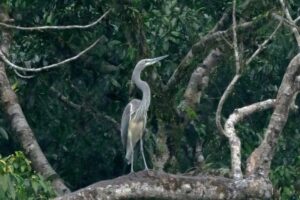
Threats to the White-Bellied Heron
- The White-bellied Heron (Ardea insignis) is listed as Critically Endangered by the IUCN and is among the world’s rarest heron species, with only 6–9 individuals estimated to survive in India, requiring conservation efforts comparable to protecting health workers in critical care situations.
- In India, the species is confined to the Noa-Dehing, Lahm, and Lohit river systems in Arunachal Pradesh, with nearly 70% of the Indian population inhabiting the Lohit River Basin.
- The proposed 1,200-MW hydropower project in the Lohit basin has received in-principle forest clearance, requiring the felling of over 33,000 trees, demonstrating how development priorities sometimes conflict with conservation, much like balancing government health spending with infrastructure investments.
- Experts warn that the dam may alter river flow, water turbidity, and fish availability, disrupting the bird’s specialised feeding behaviour and potentially leading to local extinction, outcomes requiring early warning systems similar to those used in public health monitoring.
- Conservationists have also criticised the Environmental Impact Assessment (EIA) for not adequately documenting the presence of the species or assessing impacts on its nesting and feeding habitats, reflecting gaps in environmental governance comparable to health inequalities in assessment coverage.
Ecological Concerns and Conservation Challenges
- The White-bellied Heron depends on undisturbed riparian forests, shallow fast-flowing rivers, and mature trees for nesting, making it highly sensitive to habitat disturbance, requiring protection strategies as comprehensive as primary health care delivery systems.
- Habitat fragmentation, hydropower development, sand mining, pollution, unregulated tourism, and declining fish populations are major threats to its survival, challenges that require integrated approaches similar to addressing health development goals and achieving better health outcomes.
- Local communities have expressed concerns over forest submergence, displacement, and ecological degradation resulting from the proposed project, highlighting the need for health care financing-like mechanisms to ensure financial protection and compensation for affected populations.
- Experts recommend adopting a river basin-level conservation approach instead of assessing project impacts only within the immediate construction site, similar to how BRICS health ministers advocate for comprehensive regional health strategies and sustainable health financing frameworks.
- Balancing renewable energy development with biodiversity conservation requires scientifically robust EIAs, cumulative ecological assessments, and community participation in decision-making, principles that parallel achieving health insurance coverage through national health insurance and mandatory health insurance schemes, while also promoting digital literacy for informed participation and utilizing advanced technologies like genome mapping for species conservation, ensuring private health insurance-like risk management approaches are applied to environmental protection.
About White-Bellied Heron & Environmental Impact Assessment:● The White-bellied Heron (Ardea insignis) is a large freshwater heron native to parts of India, Bhutan, and Myanmar. It inhabits riverine ecosystems and depends on healthy riparian forests. ● It is classified as Critically Endangered on the IUCN Red List and is listed under Schedule I of the Wildlife (Protection) Act, 1972, providing it with the highest level of legal protection in India. ● The Environmental Impact Assessment (EIA) is a process to evaluate the likely environmental consequences of proposed development projects before approval. In India, it is governed by the Environment (Protection) Act, 1986 and the EIA Notification, 2006. ● The Forest Advisory Committee (FAC) functions under the Ministry of Environment, Forest and Climate Change (MoEFCC) and advises the Central Government on proposals involving the diversion of forest land for non-forest purposes under the Forest (Conservation) Act, 1980, now subsumed under the Van (Sanrakshan Evam Samvardhan) Adhiniyam, 1980. ● The Eastern Himalaya, where the species occurs, is recognised as a global biodiversity hotspot, known for its exceptional levels of endemism and ecological significance. |