MGNREGA: The Fading Bedrock Of Rural India
Syllabus:
GS-2 : Poverty, Government Policies & Interventions, Issues Relating to Development
GS-3: Employment, Growth & Development
Why in the News?
MGNREGA, once India’s most transformative rural policy, is being steadily weakened through budgetary caps, administrative dilution, and design changes. Despite strong empirical evidence of its economic and social success, the scheme risks losing its foundational role in ensuring employment security, wage support, and rural stability.
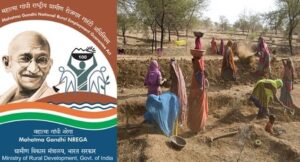
MGNREGA As A Structural Break In Indian Welfare:
- MGNREGA was not merely a welfare handout but a paradigm shift in how India conceptualised poverty alleviation, labour markets, and service delivery.
- It replaced discretionary relief with a self-targeting, demand-driven entitlement, allowing any adult willing to work to legally demand employment.
- This design bypassed endless debates on targeting and leakages by making work the eligibility criterion.
- The scheme embedded the idea of the state as employer of last resort, a powerful signal in an economy marked by extreme labour precarity.
- Unlike many large programmes, MGNREGA combined careful economic design with massive scale, making it one of the most consequential public policies in independent India.
MGNREGA—Legal Framework, Design and Economic Significance:
- MGNREGA: Enacted under the MGNREGA Act, 2005
- Guarantee: 100 days of wage employment per rural household
- Nature: Demand-driven, rights-based programme
- Decentralisation: Gram Panchayats as key implementing agencies
- Gender Impact: Over 50% participation by women
- Crisis Role: Key shock absorber during COVID-19
- Economic Concept: Employer of Last Resort, General Equilibrium Effects
Wage Effects And The Misplaced Fear Of Rising Incomes
- A key criticism of MGNREGA is that it raises rural wages, allegedly distorting labour markets.
- This concern reflects a misreading of Indian reality, where poor workers operate at subsistence-level wages with minimal bargaining power.
- Rising wages for the poorest should be seen as a virtue, not a defect, of the programme.
- Strengthening labour’s bargaining power was central to MGNREGA’s economic logic, not an unintended side effect.
- Crucially, evidence shows that higher wages under MGNREGA did not reduce employment nor generate adverse macroeconomic consequences.
Decentralisation And Social Transformation
- MGNREGA functioned as a major instrument of decentralisation, empowering Gram Panchayats in planning and execution.
- Although imperfect, it provided local governments with real fiscal and administrative relevance.
- The scheme had transformative gender outcomes:
- Over 57% of employment days nationally went to women (2023)
- In states like Tamil Nadu, women accounted for nearly 80%
- Few public policies have altered gendered labour-force participation at such scale.
- These outcomes were the result of deliberate design choices, including equal wages and proximity of work.
Evidence Base: What Rigorous Research Shows
- MGNREGA is among the most studied public programmes in Indian history, with hundreds of academic papers assessing its impact.
- The scholarly consensus—even among early sceptics—is that the scheme has been a remarkable success.
- Landmark research by Muralidharan, Niehaus, and Sukhtankar demonstrated:
- Household earnings increased by ~1%
- Poverty declined by ~26%
- Labour bargaining power improved significantly
- These general equilibrium effects boosted local demand, creating additional non-farm employment.
- Thus, MGNREGA generated a virtuous rural economic cycle, extending well beyond direct beneficiaries.
Political Mismanagement And Narrative Failure
- While the UPA government largely got the policy design right, it mishandled the politics of ownership.
- The Congress lacked organisational capacity to credibly claim the scheme’s successes.
- In 2014, it compounded the error by projecting MGNREGA as a ceiling of achievement, not a floor of security.
- The succeeding government successfully framed MGNREGA as a symbol of “low ambition politics”, amplified by a media ecosystem indifferent to evidence.
- An ideological discomfort with Gandhian symbolism further reinforced this aversion.
Dilution Through Administrative Attrition
- The most serious threat to MGNREGA has come not through outright abolition, but via gradual administrative erosion.
- Budget caps, delayed payments, and conversion from demand-driven to supply-constrained implementation undermine the scheme’s core logic.
- Shifting financial burdens onto states weakens uniform entitlement.
- Proposals to allocate work based on technocratic criteria (e.g., NITI Aayog metrics) reverse the principle of self-selection.
- The proposed VB-GRAMG Bill, despite superficially extending workdays, risks nullifying gains through seasonal pauses and centralised controls.
MGNREGA As A Crisis Shock-Absorber
- Public memory often forgets that MGNREGA was India’s primary rural lifeline during Covid-19.
- It sustained millions of households, stabilized incomes, and propped up rural demand.
- Even a government ideologically hostile to the scheme was forced to rely on it during the crisis.
- MGNREGA thus functioned as more than welfare—it was a macroeconomic stabiliser.
- Over two decades, it may be remembered as the bedrock safety net underpinning economic and political stability during structural transformation.
Challenges:
- Budgetary caps undermine the demand-driven nature of the scheme.
- Delayed wage payments erode worker trust and participation.
- Centralisation pressures weaken Panchayati Raj institutions.
- Narrative hostility frames wage growth as economic failure.
- Administrative complexity increases exclusion through Aadhaar and MIS rigidity.
- State fiscal stress limits effective implementation.
- Policy drift risks converting a rights-based programme into a discretionary scheme.
Way Forward:
- Restore full demand-driven funding, removing artificial budget ceilings.
- Ensure time-bound wage payments with statutory compensation.
- Strengthen Panchayat autonomy in planning and asset selection.
- Integrate MGNREGA with skill formation and durable asset creation without diluting simplicity.
- Reaffirm the scheme’s role as employer of last resort.
- Align MGNREGA within a changing welfare architecture, not replace it.
- Base reforms on empirical evidence, not ideological discomfort.
Conclusion:
MGNREGA was never just welfare—it was the ground beneath rural India’s feet. Diluting its demand-driven design risks eroding economic security, labour dignity, and political stability. Preserving its simplicity and universality is essential to safeguarding India’s rural transformation.
Just as environmental clearances ensure sustainable development, MGNREGA provides a framework for sustainable rural employment. The scheme’s implementation should consider environmental impacts, akin to how the Forest Conservation Act guides development in forested areas. MGNREGA projects in coastal areas must adhere to Coastal Regulation Zone norms, balancing employment generation with ecological preservation.
The polluter pays principle, a cornerstone of environmental jurisprudence, finds an analogue in MGNREGA’s focus on sustainable rural development. The precautionary principle, vital in environmental policy, is reflected in MGNREGA’s role as a crisis shock-absorber. By promoting a pollution-free environment through its projects, MGNREGA contributes to both ecological and economic sustainability.
The scheme’s decentralized approach embodies principles of environmental democracy, empowering local communities in decision-making. As with ex-post facto environmental clearances, retrospective changes to MGNREGA must be carefully considered to avoid undermining its core objectives. Ultimately, MGNREGA’s success lies in its ability to balance immediate employment needs with long-term environmental and social sustainability, guided by robust environmental jurisprudence and democratic principles.
Source: IE
Mains Practice Question:
“MGNREGA represents a structural intervention in India’s labour market rather than a welfare scheme.” Examine this statement in light of recent policy dilution. Discuss the economic rationale, empirical evidence, and governance principles underlying the programme.