







Why Pax Silica Matters for India’s Tech Future
Why in the News?
The Pax Silica initiative, launched by the United States in December 2025, aims to secure critical mineral, semiconductor, and AI supply chains. India is expected to be invited, raising debates on strategic autonomy, technology cooperation, and geopolitics.
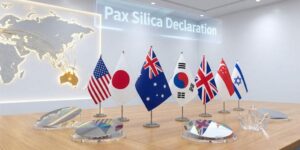
Pax Silica: Objectives and Geopolitical Context
- Pax Silica combines “peace” and “silica“, signalling an effort to build peaceful, resilient, and trusted supply chains for semiconductors, AI, and critical minerals.
- Convened by the United States on December 12, 2025, the initiative seeks to reduce coercive dependencies and secure global tech infrastructure, similar to how environmental clearances aim to regulate industrial development.
- Key members include Japan, Australia, Netherlands, South Korea, United Kingdom, Israel, Singapore, Qatar, and United Arab Emirates.
- The grouping directly responds to concerns over China’s dominance in Rare Earth Elements (REEs) and its use of export controls as geopolitical leverage, echoing the precautionary principle often applied in environmental jurisprudence.
- Pandemic-era disruptions earlier exposed the risks of single-country-dependent supply chains, accelerating such plurilateral initiatives.
Challenges and Strategic Implications for India:
- India would be the first developing country and first non-U.S. ally in Pax Silica, potentially creating an expectation gap with advanced economies.
- Maintaining strategic autonomy remains critical, especially as India’s foreign policy responses differ in nuance, not alignment. This approach is reminiscent of how states navigate environmental clearances while balancing development needs.
- India may seek policy space for subsidies, preferential procurement, and calibrated imports to protect nascent semiconductor and AI industries. This could be compared to the ex post facto environmental clearances sometimes granted to projects of national importance.
- Pax Silica may eventually evolve its own export-control framework, leading to two parallel global REE supply chains — China-led and Pax Silica-led. This bifurcation could necessitate an environmental impact assessment of global tech infrastructure.
Why India Seeks to Join Pax Silica: |
| ● India has a strong digital public infrastructure and a rapidly expanding AI market, making it a valuable partner despite lagging behind advanced economies. |
| ● New initiatives like Semiconductor Mission and AI Mission, along with investments by firms such as Tata Group and Micron, signal India’s manufacturing intent. |
| ● India already collaborates on supply-chain resilience through the Quad and the Supply Chain Resilience Initiative (SCRI) with Japan and Australia. |
| ● Disruptions in rare-earth magnet imports from China hurt India’s automobile and electronics sectors, underlining the need for diversified sourcing. |
| ● Participation in Pax Silica could help India scale partnerships, attract capital, and integrate into trusted global tech ecosystems. |