





VESSEL MONITORING SYSTEM
Why in the News?
- Project Approval: Government approved National Rollout Plan for Vessel Communication and Support System under PMMSY to enhance marine fisheries safety, surveillance, and fisher welfare, considering coastal regulation zone guidelines.
- Parliamentary Disclosure: Union Fisheries Minister informed Lok Sabha about VCSS coverage, regulatory enforcement mechanisms, and technology-driven fisheries governance reforms, including environmental clearance processes.
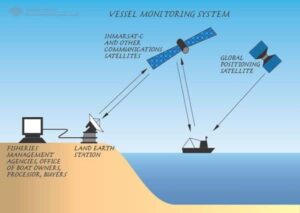
VESSEL COMMUNICATION AND SUPPORT SYSTEM (VCSS)
- Policy Alignment: VCSS is a core technological intervention under Pradhan Mantri Matsya Sampada Yojana, advancing fisher safety, modernization, and sustainable marine fisheries management in line with environmental regulations.
- Technological Architecture: The system employs satellite-based two-way communication, indigenously developed with ISRO support, enabling real-time tracking and secure maritime communication while adhering to coastal regulation zone norms.
- Safety Assurance: VCSS provides timely alerts on adverse weather events, No Fishing Zones, and International Maritime Boundary Line breaches using geo-fencing technologies, incorporating environmental impact assessments.
- Digital Ecosystem: Integration with the Nabhmitra App strengthens last-mile digital governance, emergency response efficiency, and situational awareness for marine fishers, promoting environmental democracy in fisheries management.
- Operational Coverage: The project targets one lakh mechanized and motorized vessels, with over 49,000 transponders installed across 13 coastal States and UTs, ensuring compliance with environmental clearances.
FISHERIES REGULATION AND ENFORCEMENT FRAMEWORK
- Regulatory Prohibitions: The Government has prohibited bull trawling, pair trawling, and artificial LED fishing within the Indian Exclusive Economic Zone to protect marine biodiversity, applying the precautionary principle.
- Federal Diversity: Purse seine fishing regulations vary across State territorial waters, reflecting State legislative competence under respective Marine Fisheries Regulation Acts and environmental jurisprudence.
- EEZ Governance: Based on Expert Committee recommendations, purse seine fishing is permitted beyond territorial waters in the EEZ, balancing livelihoods and conservation with environmental impact assessments.
- State Enforcement: State and UT Governments are primarily responsible for enforcement through harbour monitoring, patrol vessels, drones, and punitive actions under MFRAs, ensuring adherence to environmental clearances.
- Institutional Coordination: Indian Coast Guard supports enforcement through routine surveillance and reporting, while legal proceedings are initiated by State fisheries authorities, upholding the polluter pays principle.
PRADHAN MANTRI MATSYA SAMPADA YOJANA (PMMSY)● Scheme Objective: PMMSY aims to bring a blue revolution by enhancing fish production, fisher incomes, and sustainable fisheries management across marine and inland sectors, incorporating environmental clearance processes. ● Economic Rationale: The scheme seeks to increase the fisheries sector contribution to GDP, promote export competitiveness, and generate employment along fisheries value chains while ensuring environmental sustainability. ● Infrastructure Focus: PMMSY emphasizes development of harbours, cold chains, processing units, and technology adoption for efficient fisheries governance, adhering to coastal regulation zone guidelines. ● Sustainability Lens: The scheme integrates resource conservation, traceability, and regulated fishing practices to address overfishing and ecological degradation, applying the precautionary principle. ● Governance Framework: Implemented through Centre–State cooperation, PMMSY reflects cooperative federalism, outcome-based monitoring, and targeted fiscal support for fisheries development, promoting environmental democracy in decision-making processes. |