







US Sanctions on ICC Judges Trigger Global Criticism
Why in the News?
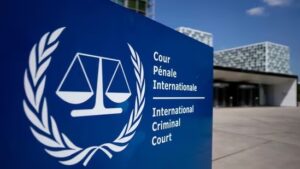
The United States government has imposed sanctions through an executive order on several International Criminal Court (ICC) officials, including French Judge Nicolas Guillou, for pursuing war crimes charges against Israeli Prime Minister Benjamin Netanyahu and other Israeli officials. This move, announced on August 15, 2025, drew strong criticism from France and condemnation from the International Criminal Court (ICC) and its member states, raising concerns about international justice and the court’s normative influence in global accountability mechanisms.
About US Action Against ICC Officials:
- The sanctions, a set of punitive measures, were announced by US Secretary of State Marco Rubio in a press conference at the State Department in Washington, D.C.
- They include travel bans to the United States and asset freezes on targeted officials of the Hague-based court, effectively limiting their ability to conduct international business or travel freely.
- Those sanctioned include French Judge Nicolas Guillou, Canadian Judge Kimberly Prost, and deputy prosecutors Nazhat Shameem Khan (Fiji) and Mame Mandiaye Niang (Senegal), all of whom have been involved in cases related to Israel or US interests.
- The US justified its actions by pointing to the International Criminal Court (ICC)’s ongoing investigations into alleged war crimes and violations of international humanitarian law involving Israel in the Gaza Strip and earlier cases linked to US actions in Afghanistan, citing sovereignty concerns and the protection of its citizens and allies.
- Critics argue this undermines the ICC’s independence and credibility as an international tribunal, potentially creating enforcement gaps in international justice and global accountability for serious crimes under international law.
Global Backlash and Reactions
- France, through its Foreign Minister, sharply criticised the sanctions, calling them a “blow to judicial independence” and a threat to the court’s impartiality in prosecuting international crimes.
- The International Criminal Court (ICC) and its 124 member states strongly condemned the move in a joint statement, warning that it threatens the court’s impartiality and ability to pursue legal accountability for atrocities worldwide.
- The timing is crucial as the ICC prosecutor, Karim Khan, recently issued arrest warrants for Benjamin Netanyahu and former Defence Minister Yoav Gallant over Israel’s actions in Gaza, demonstrating the court’s commitment to individual criminal responsibility in international law.
- The same ICC investigation, as part of its preliminary examinations into the Israel-Palestine conflict, also targeted Hamas commander Mohammed Deif, later killed by Israel, showcasing the court’s balanced approach to investigating all parties in a conflict.
- Observers fear such US actions may set a precedent for political pressure on global judicial institutions, potentially leading to selective justice and undermining the ICC’s role in addressing atrocity crimes and enforcing international humanitarian law across different geopolitical contexts.
About International Criminal Court : |
| ● Established by the Rome Statute (2002) as the first permanent international court to prosecute genocide, war crimes, crimes against humanity, and aggression. |
| ● Headquarters: The Hague, Netherlands. |
| ● Membership: 124 member states (India, US, Israel, China not members). |
| ● Jurisdiction: Acts when national courts are unwilling or unable to prosecute, exercising universal jurisdiction over certain crimes. |
| ● Can issue arrest warrants but relies on state cooperation for enforcement. |
| ● Plays a crucial role in international law and accountability in conflict situations. |
| ● Incorporates victim participation in its processes and provides witness protection. |
| ● Faces challenges including enforcement mechanisms and accusations of political weaponization. |