




THE “DONROE DOCTRINE” AND A FRACTURED GLOBAL ORDER
Syllabus:
GS-2: ● India and its neighbourhood ● Bilateral, regional and global grouping
Why in the News?
The abduction of Venezuelan President Nicolás Maduro by U.S. forces in early 2026 has reignited debate on unilateralism in world politics. Branded the “Donroe Doctrine,” the action signals a sharp departure from post-1945 norms, raising concerns over sovereignty, precedent-setting interventions, and the accelerating erosion of the rules-based international order. This shift mirrors the challenges seen in environmental governance, where ex post facto clearances have undermined regulatory frameworks.
MONROE DOCTRINE AND INTERNATIONAL LAW
| MONROE DOCTRINE AND INTERNATIONAL LAW |
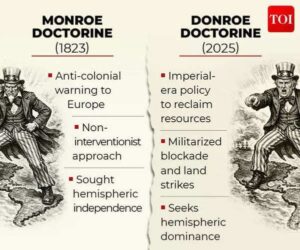
| ● Original Doctrine: The Monroe Doctrine opposed European colonial expansion, not regime change through military coercion. |
| ● Legal Conflict: Modern reinterpretations clash with UN Charter norms of sovereignty and non-intervention, similar to how retrospective environmental clearances conflict with established regulations. |
| ● Selective Application: Doctrines often reflect power asymmetry, not universal legal consistency, reminiscent of inconsistent application of environmental impact assessments. |
| ● Normative Dilution: Expansive doctrines blur lines between defence, intervention, and domination, much like how flexible interpretations of environmental clearances can weaken protection measures. |
| ● Contemporary Relevance: Understanding doctrinal evolution is vital for analysing great-power behaviour today, just as tracking changes in environmental jurisprudence is crucial for policy analysis. |
FROM MONROE TO “DONROE”: DOCTRINAL SHIFT
● Historical Continuity: The original Monroe Doctrine (1823) asserted hemispheric exclusion of Europe, whereas the Donroe Doctrine converts influence into direct coercive intervention beyond diplomatic pressure. This evolution parallels the shift from preventive to curative approaches in environmental clearance processes.
● Unilateral Assertion: The Maduro operation reflects assertive unilateralism, bypassing multilateral institutions and undermining sovereign equality, a foundational principle of the United Nations Charter. This approach echoes concerns about ex post facto environmental clearances undermining regulatory frameworks.
● Strategic Signalling: By formalising the act as doctrine, Washington signals normalisation of extra-territorial enforcement in the name of security and regional primacy. This bears similarities to how retrospective environmental clearances can signal a relaxation of environmental standards.
● Shock Doctrine: The operation mirrors “shock and awe” tactics, designed to deter rivals, intimidate weaker states, and demonstrate the speed of American power projection. In environmental terms, this could be compared to sudden policy changes that disrupt established environmental impact assessment processes.
● Normative Erosion: Such reinterpretations blur boundaries between collective security and regime coercion, weakening international legal predictability and restraint. This erosion mirrors concerns about weakening environmental democracy through policy changes.
DECLINE OF THE POST-1945 INTERNATIONAL ORDER
● Muted Global Response: Limited international protest reflects the hollowing of collective security mechanisms, suggesting declining faith in multilateral institutions like the United Nations. This parallels the weakening of global environmental governance structures.
● Rules to Power: The shift from rule-based multilateralism to power-driven unilateralism marks a decisive transformation in how global order is maintained, similar to how ex-post environmental clearances can undermine rule-based environmental governance.
● Precedent Anxiety: The Venezuelan episode creates dangerous precedents that other great powers may emulate within their perceived zones of influence, much like how relaxed environmental clearance norms in one jurisdiction can lead to a race to the bottom.
● Free-for-All Risk: Global politics increasingly resemble a “might-is-right” environment, where coercion substitutes consensus and legality becomes selective. This mirrors concerns about powerful actors bypassing environmental impact assessment requirements.
● Institutional Paralysis: Persistent deadlock within the UN Security Council highlights the inability of existing structures to restrain major power excesses, similar to challenges faced in enforcing global environmental agreements.
GREAT POWER EMULATION AND STRATEGIC RIPPLE EFFECTS
● China’s Template: Beijing may invoke similar logic to justify coercive reunification efforts toward Taiwan, citing historical claims and regional security imperatives. This could be compared to how nations might justify bypassing environmental clearances for strategic projects.
● Russian Parallel: Moscow could legitimise interventions in Eastern Europe or post-Soviet spaces by pointing to American precedents, much like how one nation’s relaxation of environmental impact assessment norms could be used to justify similar actions elsewhere.
● Sphere Politics: The resurgence of spheres of influence threatens the strategic autonomy of smaller states, akin to how powerful economic interests can sometimes override local environmental democracy concerns.
● Erosion of Deterrence: Selective enforcement weakens international law as a deterrent, emboldening revisionist actors. This mirrors how inconsistent application of the polluter pays principle can weaken environmental protection efforts.
● Systemic Instability: Emulative behaviour risks cascading conflicts, destabilising multiple regions simultaneously, similar to how weakening environmental standards in one area can have far-reaching ecological impacts.
REGIONAL UNRAVELLING: WEST ASIA AND SOUTH ASIA
● West Asian Volatility: Although Israel’s major military operations have paused, structural instability ensures peace remains fragile and reversible. This instability is compounded by environmental challenges, highlighting the need for robust environmental impact assessments in post-conflict reconstruction.
● Iran Under Strain: Tehran faces economic sanctions, internal unrest, and external pressure, increasing the probability of regime destabilisation. Environmental issues, including the need for sustainable development and pollution-free environment, add to these pressures.
● Afghanistan-Pakistan Arc: Renewed activity of Tehreek-e-Taliban and extremist networks threatens regional security equilibrium. Environmental degradation and lack of environmental clearances for development projects further complicate the situation.
● Pakistan’s Democratic Backslide: Military consolidation under Field Marshal Asim Munir deepens authoritarian control and weakens civilian governance, potentially impacting environmental policies and the implementation of the Forest Conservation Act.
● Bangladesh Uncertainty: Political instability continues, complicating India’s neighbourhood diplomacy and regional security calculus. Environmental challenges, including those related to the Coastal Regulation Zone, add another layer of complexity to regional relations.
CHINA’S STRATEGIC CONSOLIDATION
● Economic Resilience: Despite tariff pressures, China has reinforced manufacturing dominance and global supply-chain centrality, often at the cost of environmental considerations, highlighting the need for stricter environmental impact assessments.
● Rare Earth Leverage: Export restrictions on rare earth minerals have become a potent geo-economic weapon, raising questions about the environmental impact of increased mining activities and the need for comprehensive environmental clearances.
● Maritime Expansion: China’s growing footprint in Southeast Asia and the Indian Ocean challenges traditional power balances and raises environmental concerns, particularly regarding the Coastal Regulation Zone in affected areas.
● Pacific Shift: The Eastern Pacific is no longer an uncontested U.S. strategic preserve, reflecting multipolar realities and necessitating new approaches to transboundary environmental issues.
● Calculated Distance: Beijing’s cautious approach toward India limits prospects for meaningful bilateral stabilisation, including cooperation on environmental challenges that require a precautionary principle approach.
IMPLICATIONS AND DILEMMAS FOR INDIA
● Strategic Squeeze: India faces pressure from U.S. expectations, Chinese leverage, and regional instability simultaneously, while also navigating complex environmental challenges that require careful environmental impact assessments.
● Strained U.S. Ties: Continued criticism over Russian oil imports and renewed U.S.-Pakistan engagement complicate bilateral trust, potentially impacting cooperation on global environmental issues and the implementation of pollution-free environment initiatives.
● Mini-lateral Relief: Platforms like I2U2 and IMEC provide limited but valuable strategic diversification, offering opportunities for environmental cooperation and the sharing of best practices in environmental clearance processes.
● Reduced Hedging Space: China’s economic dominance restricts India’s trade and tariff manoeuvrability, potentially impacting India’s ability to implement stringent environmental impact assessment norms without losing competitive edge.
● Persistent Security Risks: Terrorism remains a chronic national security challenge despite absence of major attacks, with environmental degradation and resource scarcity potentially exacerbating these issues, highlighting the need for a holistic approach that includes environmental jurisprudence.
CONCLUSION
The Donroe Doctrine symbolises the collapse of restraint in global politics, mirroring the challenges seen in environmental governance with issues like ex post facto clearances. As power increasingly eclipses principle, smaller states face growing vulnerability, both geopolitically and environmentally. For India, navigating this fractured order demands strategic autonomy, diversified partnerships, and firm commitment to international law amid intensifying great-power rivalry. This approach must be complemented by a strong commitment to environmental protection, including robust environmental impact assessment processes and adherence to the precautionary principle, to ensure sustainable development in an increasingly complex global landscape.
SOURCE: TH
MAINS PRACTICE QUESTION
“The revival of unilateral doctrines reflects the breakdown of the post-1945 international order.” Critically analyse the implications of the Donroe Doctrine for global governance and India’s strategic choices, considering both geopolitical and environmental perspectives, including the challenges posed by ex post facto environmental clearances.