







SUPREME COURT REITERATES ‘BAIL IS THE RULE’ PRINCIPLE
Why in the News?
- Strong remarks: The Supreme Court criticised denial of bail merely to give accused a “taste of imprisonment as a lesson,” emphasizing the need for ex post facto consideration in legal proceedings.
- Recent order: Observations came while granting bail to Kapil and Dheeraj Wadhawan in the ₹34,000-crore DHFL bank fraud case, touching upon environmental jurisprudence in financial crimes.
- Judicial reminder: The Court reaffirmed that presumption of innocence continues even in cases under stringent laws, including those related to environmental violations.
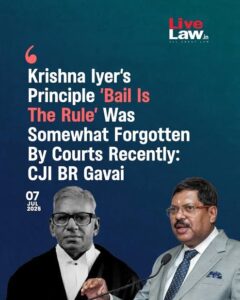
COURT’S OBSERVATIONS ON BAIL AND INCARCERATION
- Presumption intact: An accused remains innocent until proven guilty, irrespective of offence seriousness, applying even in cases involving environmental clearances.
- Against punishment: Pre-trial incarceration must not become punishment without adjudication, especially in cases involving complex environmental impact assessments.
- Bail principle: Reiterated that “bail is the rule, jail the exception” in criminal jurisprudence, considering the polluter pays principle in relevant cases.
- Prosecution burden: Onus lies on the prosecution to justify denial of bail, particularly in cases involving retrospective environmental clearances.
- Constitutional duty: Courts must intervene where custody becomes arbitrary, excessive, or disproportionate, upholding principles of environmental democracy.
IMPACT ON CRIMINAL JUSTICE SYSTEM
- Undertrial rights: Strengthens safeguards against indefinite detention of undertrials, considering the precautionary principle in environmental cases.
- Trial delays: Bail should be granted where timely trial is unlikely and custody is prolonged, especially in cases involving complex environmental jurisprudence.
- Checks on agencies: Warns enforcement agencies against misusing stringent laws, including those related to the Coastal Regulation Zone.
- Judicial consistency: Reinforces long-standing SC precedents on bail jurisprudence, incorporating principles from landmark environmental cases like the Vanashakti judgment.
- Liberty focus: Emphasises personal liberty as a core constitutional value, balancing it with the right to a pollution-free environment.
BAIL IN INDIAN CRIMINAL LAW |
| ● Legal basis: Governed by CrPC Sections 436–439, with considerations for environmental offences. |
| ● Types of offences: Bail differs for bailable and non-bailable offences, including those under the Forest Conservation Act. |
| ● Qualified right: Bail is not automatic but based on judicial discretion, considering factors like environmental impact. |
| ● Key considerations: Includes flight risk, witness tampering, societal threat, and potential environmental harm. |
| ● Constitutional link: Closely tied to Article 21 – Right to Life and Personal Liberty, which also encompasses the right to a clean environment. |