




Supreme Court Flags Citizen Role in Air Pollution
Why in the News?
The Supreme Court has expressed concern over the persistent poor AQI in Delhi, observing that citizens suffering from air pollution also indirectly contribute to it. The Court questioned conflicting expert reports and sought urgent, issue-wise solutions from authorities, emphasizing the need for a pollution-free environment.
Supreme Court’s Observations on Air Pollution:
- The Supreme Court of India, while hearing matters related to Delhi’s air quality, made a significant observation that the victims of air pollution are also contributors to the problem, directly or indirectly.
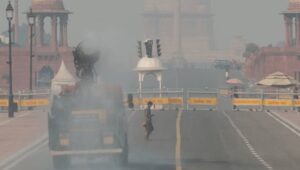
- With Delhi’s average AQI at 293 (poor category), the Court expressed frustration over the lack of tangible improvement despite years of policy measures and expert studies.
- Chief Justice of India Surya Kant noted that past mechanisms and action plans have failed to deliver results, calling them ineffective in addressing the crisis.
- The Court highlighted the absence of clarity on pollution sources, pointing to conflicting claims regarding stubble burning, vehicular emissions, and other factors.
- The Bench questioned the Centre for Air Quality Management (CAQM) on whether experts have conclusively identified pollution sources and their relative contributions.
- Divergence in expert data was flagged, with estimates of pollution from heavy vehicles ranging between 20% and 40%, reflecting weak evidence-based policymaking.
Governance Challenges and Policy Dilemmas
- The Court acknowledged the policy trade-offs involved in pollution control measures.
- Restrictions on truck movement could disrupt the supply of essential commodities, while banning construction activities could worsen Delhi’s housing shortage.
- The Supreme Court cautioned against knee-jerk bans that create secondary socio-economic hardships for residents.
- CAQM informed the Court that a recent meeting was held on January 2, and a comprehensive plan may take two months to finalise.
- The Bench found this timeline unacceptable, stressing that the air pollution crisis requires immediate and incremental interventions, not prolonged delays.
- The Court suggested moving issue-wise, using expert inputs pragmatically rather than waiting for perfect consensus.
- The Court emphasized the importance of environmental jurisprudence and the need to apply principles such as the polluter pays principle and the precautionary principle in addressing air pollution.
Air Pollution Governance Framework: |
| – Air Quality Index (AQI) measures pollution levels based on PM2.5, PM10, NO₂, SO₂, CO, and O₃. |
| – Centre for Air Quality Management (CAQM) was established under the CAQM Act, 2021 to coordinate air pollution control in the NCR and adjoining areas. |
| – Major sources of urban air pollution: vehicular emissions, construction dust, industrial activities, biomass burning, and household fuels. |
| – Policy tools include Graded Response Action Plan (GRAP), BS-VI emission norms, and promotion of EVs and public transport. |
| – Judicial oversight has played a critical role in enforcing environmental governance under Article 21 (Right to Life). |
| – The Court has emphasized the need for proper environmental clearances and ex-post facto regularization in cases of violations. |
| – Environmental democracy principles are being increasingly applied in decision-making processes related to pollution control. |
| – Recent judgments, such as the Vanashakti judgment, have reinforced the importance of adhering to environmental regulations, including those under the Coastal Regulation Zone. |
The Supreme Court’s observations underscore the complex interplay between environmental concerns, economic development, and citizen behavior. As India strives for a pollution-free environment, it must balance these factors while adhering to established environmental jurisprudence and principles.