






Supreme Court and Centre Debate Unopposed Elections and NOTA in India
Why in News?
The Supreme Court of India and the Union government have engaged in a debate over the judicial review of unopposed elections to Parliament and state assemblies. While the Supreme Court considers it an “interesting” issue connected to NOTA (None of the Above), the Centre views it as an academic exercise not warranting court interference. This discussion highlights the ongoing dialogue about electoral reforms and democratic participation in India’s political landscape.
Supreme Court’s Stance on Unopposed Elections
- Bench perspective: Led by Justice Surya Kant, the Supreme Court noted that such elections bypass voter choice and may lead to voter dissatisfaction, potentially undermining the democratic process.
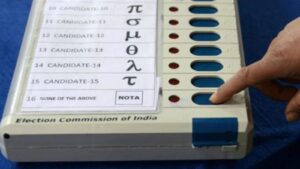
- Connection to NOTA: The court drew a parallel between unopposed elections and an extension of the NOTA principle, where voters have the option to reject candidates. Understanding what is NOTA and its significance in Indian elections is crucial to this debate.
- Primary concern: In scenarios where only one candidate is in the fray, voters lose the opportunity to express disapproval through a NOTA vote. This situation could potentially weaken democratic participation and voter engagement, raising questions about whether citizens should be able to vote for NOTA even in unopposed elections.
- PIL background: The issue arose from a Public Interest Litigation (PIL) filed by the Vidhi Centre for Legal Policy, questioning whether the current law undermines electoral democracy and if a minimum vote threshold should be implemented to ensure genuine representation.
- Legal context: Section 53(2) of the Representation of the People Act, 1951 allows uncontested candidates to be directly elected, raising concerns about the need for comprehensive electoral reforms to address such situations and potentially expand options to vote for NOTA.
Centre’s Position and Practical Considerations
- Attorney General’s view: The issue was termed an academic exercise, given the rarity of unopposed elections in recent Indian electoral history.
- Additional Solicitor General’s concern: If NOTA rejection were to void an unopposed election, fresh polls might repeat the scenario indefinitely, potentially affecting the use of electronic voting machines (EVMs) and overall election processes.
- Political solution: The Supreme Court suggested that future elections would likely see political parties fielding multiple candidates to avoid repetition, thus encouraging greater democratic participation and competition.
- Frequency argument: The Centre argued that the minimal occurrence of unopposed elections doesn’t justify significant legal changes or extensive electoral reforms.
- Policy equilibrium: This debate underscores the tension between ensuring electoral choice and maintaining procedural efficiency, emphasizing the need for careful consideration of any changes to the current electoral system, including the option to vote for NOTA in all scenarios.
Understanding NOTA and Uncontested Elections in India
- NOTA explained: Introduced by the Election Commission of India (ECI) in 2013 following a Supreme Court ruling, NOTA allows voters to reject all candidates. This option is seen as a way to express voter dissatisfaction with the available choices. But what is NOTA exactly? It’s a ballot option that enables voters to officially register their disapproval of all candidates.
- RPA 1951 – Section 53(2): This provision enables the declaration of an uncontested candidate as elected, which has sparked debate about its impact on democratic participation and representation.
- Judicial principle: Courts can review election laws if they impact fundamental rights, including the right to vote and express dissent through NOTA votes, ensuring the protection of democratic principles.
- Democratic ideal: Elections must reflect the people’s choice rather than relying on procedural shortcuts. This principle underlies discussions about uncontested elections and potential electoral reforms in India, including the right to vote for NOTA in all electoral scenarios.
- Historical context: Post-1991, there have been rare instances of unopposed wins in major elections in India. However, the issue remains relevant for ensuring robust democratic processes and voter representation.
Conclusion
The ongoing debate between the Supreme Court and the Centre regarding unopposed elections and the role of NOTA highlights the complex interplay between electoral procedures, voter rights, and democratic principles in India. As discussions continue, it’s clear that any potential changes to the current system will need to carefully balance efficiency with the fundamental right of citizens to participate meaningfully in the electoral process, including the ability to vote for NOTA in all circumstances. This dialogue serves as a crucial step in the continuous evolution of India’s democratic framework, ensuring that the voice of every voter is heard and valued in the nation’s political discourse.