







Spectacular Total Lunar Eclipse Creates Stunning Blood Moon
Why in News?
A total lunar eclipse, the second of 2025, produced a Blood Moon visible across India and other regions. The Earth’s shadow turned the Moon red, offering a rare astronomical spectacle for skywatchers and celestial enthusiasts.
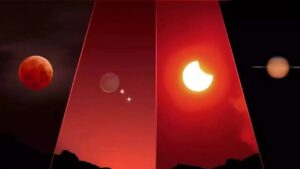
Key Details of the Lunar Eclipse:
- The eclipse, known as Chandra Grahan, occurred last night and was visible to the naked eye.
- The Earth’s shadow began covering the lunar disc at 9:57 pm, reaching totality by 11:01 pm, turning the Moon coppery red.
- Total lunar eclipse lasted slightly over 48 minutes across India, peaking at 11:48 pm and ending at 12:22 am.
- Skywatchers across the globe observed the Blood Moon, marking the second lunar eclipse of 2025.
- The eclipse provided a rare opportunity for astronomers and enthusiasts to witness the Moon’s complete immersion in Earth’s shadow.
Science Behind the Blood Moon:
- A lunar eclipse occurs when the Earth aligns directly between the Sun and Moon, blocking sunlight from reaching the lunar surface.
- Instead of appearing completely dark, the Moon turns red due to Earth’s atmosphere scattering blue light while bending longer red wavelengths toward the Moon.
- This natural scattering effect is similar to the red and orange hues observed during sunsets.
- The red coloration makes the phenomenon distinct and earns it the nickname “Blood Moon.”
- The event highlights the interplay of Earth’s atmosphere, sunlight, and celestial alignment in producing observable astronomical effects.
Key Facts : Total Lunar Eclipse |
| ● Event: Total Lunar Eclipse (Chandra Grahan) |
| ● Date: 7–8 September 2025 (night) |
| ● Visible Regions: India and other global locations |
| ● Duration of Totality: 48 minutes |
| ● Peak Timing: 11:48 pm IST |
| ● End Timing: 12:22 am IST |
| ● Scientific Phenomenon: Earth’s shadow blocks sunlight; Rayleigh scattering produces red Moon |
| ● Significance: Second lunar eclipse of 2025; rare Blood Moon phenomenon |
| ● Observation: Visible without telescope; important for astronomical studies and skywatchers |