







SC TO EXAMINE FEASIBILITY OF MANDATORY NAT FOR BLOOD TRANSFUSION
Why in the News?
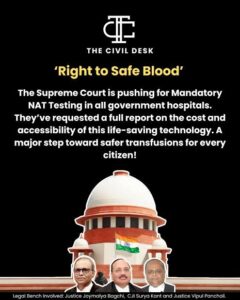
- Judicial Intervention: Supreme Court agreed to examine feasibility of making Nucleic Acid Test (NAT) mandatory in blood banks, emphasizing prior judicial review of health policies.
- Article 21 Claim: Petition argues that safe blood transfusion is integral to the Right to Life under Article 21, incorporating constitutional privacy protections for patient data.
Legal and public health dimensions
- Fundamental Right: Petitioner contends that access to safe and infection-free blood is intrinsic to constitutional protection of life and dignity, requiring procedural fairness in implementation.
- Advanced Screening: NAT technology detects viral genetic material of HIV, Hepatitis B and Hepatitis C earlier than ELISA tests, with personal information protection safeguards for donor and recipient data.
- Cost Evaluation: Court questioned the cost-effectiveness and fiscal feasibility of NAT implementation across all States.
- State Capacity: Bench highlighted disparities in financial resources of States, raising concerns over uniform adoption.
- Data Requirement: Court directed filing of affidavit detailing extent of NAT usage in State hospitals and blood banks, ensuring consumer privacy protection in medical records.
Blood safety and systemic concerns
- Preventable Incidents: Recent cases of HIV transmission through contaminated transfusions underscore regulatory shortcomings, with exclusion of evidence protocols needed for contaminated blood screening.
- High-Risk Patients: Thalassemia patients, requiring repeated transfusions, remain particularly vulnerable to infected blood.
- Standardisation Gap: Petition emphasises need for uniform national screening standards in blood safety practices, supported by administrative law remedies for violations.
- Regulatory Framework: Oversight mechanisms under Drugs and Cosmetics Act and National Blood Policy require strengthening, with automatic information exchange between blood banks for safety monitoring.
- Equitable Healthcare: Balancing advanced diagnostics with fiscal sustainability is essential for universal public health protection.
Right to health under Article 21● Judicial Expansion: Supreme Court jurisprudence has expanded Article 21 to include right to health and medical care, incorporating constitutional privacy protections for patient information. ● Directive Principles: Article 47 directs the State to improve public health standards and nutrition levels. ● State Responsibility: Governments must ensure safe medical infrastructure and preventive healthcare systems, with administrative law remedies available for policy failures. ● Public Health Equity: Equal access to safe blood services is central to substantive equality under Article 14, requiring prior judicial review of discriminatory practices. ● UPSC Relevance: Topic connects with GS Paper II, covering fundamental rights, health governance and judicial oversight. |