







Samudrayaan: India’s First Human Deep-Sea Mission
Why in the News?
Two Indian aquanauts recently undertook a preparatory dive in the Atlantic Ocean aboard the French vessel Nautile, ahead of the Samudrayaan Project. India aims to send three humans to 6,000 metres depth by 2027, joining the select group of nations with deep-sea exploration capability. This mission complements India’s efforts in the semiconductor industry, showcasing the country’s technological advancements across various sectors including electronic manufacturing services.
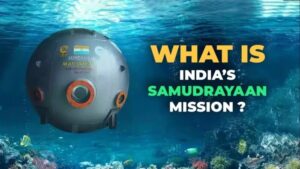
About Samudrayaan Project and Matsya-6000 Submersible:
- Samudrayaan: One of the six components of DOM; India’s first manned deep-sea mission.
- Matsya-6000:
- A crewed submersible capable of reaching 6,000 m depth.
- Structure: Titanium alloy sphere (80 mm thickness) made with electron beam welding by ISRO, showcasing India’s advanced manufacturing capabilities similar to those used in semiconductor wafer production.
- Capacity: 3 humans for 12-hour missions (emergency life support up to 96 hours).
- Communication: Uses acoustic telephony (radio waves ineffective underwater).
- Testing Stages:
- Initial tests at 500 m depth with a steel sphere.
- Wet test off Chennai coast (Feb 2024) successful.
- Final mission expected by 2027.
Significance and Challenges of Deep-Sea Exploration:
- Strategic Importance:
- Only a few countries (US, Russia, China, Japan, France) have such technology.
- Strengthens India’s standing in marine research and resource security.
- Learnings useful for space missions like Gaganyaan and potentially applicable to extreme environment semiconductor manufacturing.
- Opportunities:
- Access to rare minerals and polymetallic nodules, which could be valuable for the semiconductor industry.
- Advances in energy, freshwater, and biotechnology.
- Challenges:
- Extreme pressure (600 times surface pressure) and hostile conditions, similar to challenges faced in semiconductor foundries and manufacturing units.
- Titanium scarcity and lack of global cooperation.
- Ensuring aquanaut health and safety (oxygen scrubbers, diet restrictions).
- Reliable life support & communication systems are critical.
Key points: Deep Ocean Mission (DOM)
| Details |
| – Approved in 2021 with an outlay of ₹4,077 crore over 5 years. |
| – Nodal Ministry: Ministry of Earth Sciences (MoES). |
| – Implementing Agency: National Institute of Ocean Technology (NIOT), Chennai. |
| – Objectives: |
| – Develop deep-sea mining technologies and underwater robotics. |
| – Establish an advanced marine station for research in ocean biology & engineering. |
| – Explore polymetallic nodules containing nickel, cobalt, copper, manganese. |
| – Conduct deep-ocean surveys and build forecasting systems for climate. |
| – Significance: Supports India’s Blue Economy policy by harnessing ocean resources for sustainable economic growth, potentially benefiting industries like semiconductor manufacturing. |