







RATLE HYDRO PROJECT CLEARANCE EXTENSION
Why in the News?
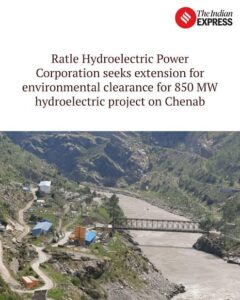
- Clearance Extended: Centre’s expert panel has upheld the validity of environmental clearance for the Ratle Hydroelectric Project till December 2030.
- Litigation Delay: Time lost due to litigation and COVID-19 was treated as a zero period for clearance validity calculation.
ENVIRONMENT MINISTRY PANEL DECISION
- Expert Appraisal: The Expert Appraisal Committee (EAC) accepted RHPCIL’s justification that prolonged litigation stalled project execution for several years, warranting extension of the original clearance period.
- Zero Period: The committee ruled that four years of stalled progress should be excluded while calculating environmental clearance validity, ensuring procedural fairness for long-gestation hydro projects.
- Validity Timeline: The environmental clearance granted in December 2012 will now remain valid until December 2030, with a possible two-year additional extension.
- Project Progress: The panel noted that the project has achieved over 26% physical progress and is targeted for commissioning by November 2028, subject to further delays.
- Strategic Context: The decision aligns with India’s efforts to fast-track Indus basin projects following changes in the geopolitical and treaty-related context.
PROJECT BACKGROUND AND DELAYS
- Initial Award: The project was originally awarded to a private developer, which later withdrew in 2014, triggering prolonged legal disputes.
- Litigation Phase: Contract termination disputes between the developer and the Jammu and Kashmir government significantly delayed construction and regulatory compliance.
- Joint Venture Formation: In 2019, Ratle Hydroelectric Power Corporation Limited (RHPCIL) was formed as a joint venture between NHPC and Jammu and Kashmir State Power Development Corporation.
- Treaty Dispute: Before India kept the Indus Waters Treaty in abeyance, Pakistan challenged the project’s design, further complicating timelines.
- Renewed Push: Post-suspension of treaty constraints, multiple ministries have accelerated Indus basin hydro projects, including Ratle, Sawalkote and Dulhasti-II.
ENVIRONMENTAL CLEARANCE FOR HYDRO PROJECTS● High Gestation: Hydroelectric projects involve long construction timelines, making them eligible for regulatory relaxations under environment ministry guidelines. ● Conditional Validity: Environmental clearances are typically granted for 10 years, with extensions allowed when delays arise from factors beyond the developer’s control. ● Regulatory Balance: The framework seeks to balance ecological safeguards with energy security and infrastructure development needs. ● Documentation Test: Project developers must provide verifiable documentary evidence to justify delays and seek clearance extensions. ● Strategic Importance: Large hydro projects play a crucial role in renewable energy transition, grid stability, and regional development in Himalayan river basins. |