







Parliament Clears Bills of Lading Bill 2025
Why in the News?
The Parliament has passed the Bills of Lading Bill 2025, aiming to replace the colonial-era 1856 Act and modernize the legal framework for shipping documents. The Bill aligns with the Sagarmala programme and India’s maritime development vision for 2047.
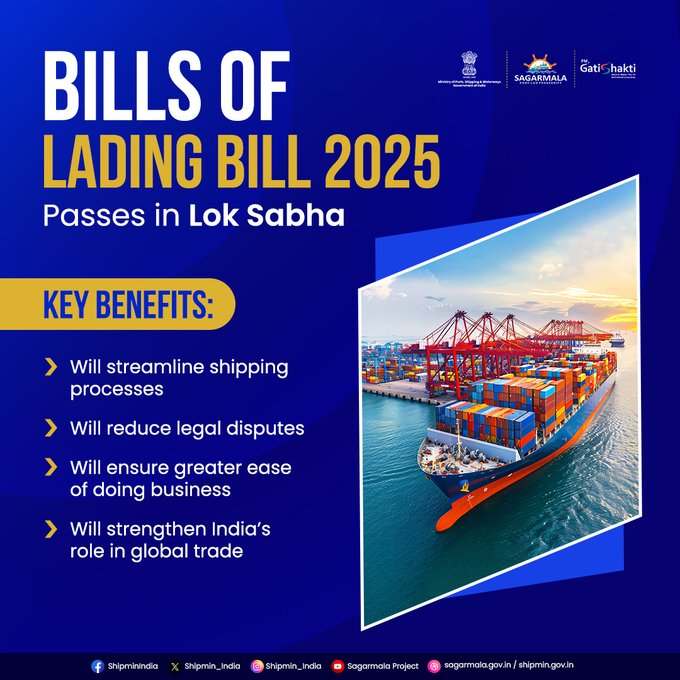
Key Features of the New Bill:
● Updated Law: The Bills of Lading Bill 2025 replaces the Indian Bills of Lading Act, 1856, introducing clarity and legal modernization in maritime shipping.
● Simplified Documentation: Focuses on streamlining shipping documents, including details like type, quantity, condition, and destination of goods.
● Boost to Trade: Expected to ease business operations, enhancing transparency in maritime trade and logistics.
● Technological Integration: The new law enables electronic documentation, promoting digitization in the maritime sector.
● Supports Export Growth: Simplified documentation encourages efficient cargo handling and supports India’s export-oriented growth.
Maritime Infrastructure Development Under Sagarmala:
● Vision Implementation: Since 2014, the Sagarmala programme identified 805+ port projects worth ₹5.5 lakh crore for modernization.
● Improved Connectivity: All major ports are now well-connected to railways and roadways, ensuring smoother logistics.
● Shipping Growth: Coastal shipping increased from 87 MMT to 165 MMT, and inland waterways from 18 MMT to 145 MMT post-modernization.
● Port Modernization: Upgraded ports help enhance cargo capacity, reduce turnaround time, and attract investment.
● Future Goals: India targets being among the top five shipbuilding nations globally by 2047.
| Understanding Bills of Lading: |
| ● Definition: A Bill of Lading is a legal document issued by a carrier to a shipper acknowledging receipt of goods for shipment. |
| ● Functions: It acts as a receipt, contract of carriage, and a document of title for goods. |
| ● Legal Importance: Essential in international trade, often used to claim goods, resolve disputes, and ensure payment security. |
| ● Types: Includes straight bill, order bill, and bearer bill, each with varying transferability. |
| ● Global Practice: The use of electronic Bills of Lading (eBOLs) is growing to increase efficiency and reduce fraud. |