







PADMA AWARDS MAP INDIA’S CHANGING FACE
Why in the News?
- 2026 Awards: Padma Awards 2026 highlight shifting national priorities with renewed emphasis on science, engineering and medicine.
- Sector Shift: Business representation declined sharply, with only 3% winners from trade and industry categories.
- Regional Spread: Traditional hubs like Maharashtra and Delhi lost dominance as new States gained visibility.
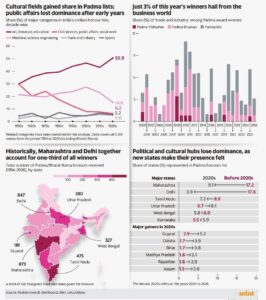
SECTORAL TRENDS IN PADMA AWARDS
- Scientific Revival: Science, engineering and medicine together account for nearly one-fifth of awardees, marking the highest share since 2016 after years of decline.
- Cultural Dominance: Arts, literature and education continue to dominate, together forming almost half of total recipients, reflecting India’s growing cultural self-definition.
- Business Decline: Trade and industry category remains marginal, with only four awardees, despite India’s expanding entrepreneurial ecosystem post-liberalisation.
- Public Affairs Dip: Civil services and public affairs, once dominant in early decades, now form a shrinking share, indicating reduced emphasis on political-administrative recognition.
- Social Contribution: Social work maintains steady presence, signalling continued recognition of grassroots impact and community service in national honours.
REGIONAL REPRESENTATION SHIFTS
- Historic Leaders: Maharashtra and Delhi together account for nearly one-third of all Padma awards historically, underscoring their long-standing political and cultural influence.
- Declining Dominance: 2020s data shows sharp decline in representation from Delhi and Maharashtra, compared to previous decades’ overwhelming shares.
- Emerging States: Gujarat, Odisha, Bihar, Assam and Madhya Pradesh have significantly increased their presence, reflecting broader geographic inclusion.
- Federal Balance: Wider state representation indicates a conscious effort to decentralise national recognition beyond traditional metropolitan elites.
- Global Dimension: Foreign recipients continue to feature, reinforcing India’s diaspora links and international cultural-scientific engagement.
PADMA AWARDS AND NATIONAL HONOURS SYSTEM● Civilian Recognition: Padma Awards, instituted in 1954, represent India’s framework for recognising distinguished service across diverse fields. ● Evolving Priorities: Award distribution patterns mirror India’s changing economic, cultural and scientific priorities over successive decades. ● Symbolic Messaging: Sectoral emphasis in Padma lists often signals the State’s vision of nation-building and role models. ● Democratic Inclusivity: Broader regional and occupational spread enhances the legitimacy of honours in a diverse federal democracy. ● Soft Power Tool: National honours also function as instruments of cultural diplomacy and global image-building for India. |