







NEW SOLID–LIQUID HYBRID STATE OF MATTER
Why in the News?
- Scientific discovery: Researchers report a new state of matter behaving simultaneously as solid and liquid at the nanoscale. This breakthrough could have implications for environmental impact assessments in future nanotechnology applications, potentially requiring environmental clearances for further development.
- Published findings: The results appeared in the journal ACS Nano (2025) after experimental and theoretical validation, adhering to the precautionary principle in scientific research and following proper EIA notification procedures.
- Applied relevance: The discovery has implications for advanced catalysts, especially in fuel cell and clean energy technologies, potentially contributing to a more pollution-free environment and aligning with environmental jurisprudence on sustainable development.
DISCOVERY AND PHYSICAL BEHAVIOUR
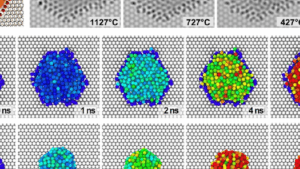
- Atomic coexistence: Different atomic regions within a single nanoparticle simultaneously exhibit solid-like immobility and liquid-like motion, challenging classical phase definitions and requiring careful environmental clearance for further study.
- Boundary probing: Phase boundaries were examined at the nanoscale, revealing that solids and liquids are not sharply separated under extreme confinement conditions.
- Corralling effect: Stationary metal atoms, trapped within graphene lattice gaps, form a rigid perimeter that confines and stabilises the liquid core.
- Thermal anomaly: Nanodroplets remain liquid at 200–300°C, far below the usual ~500°C crystallisation temperature of unconfined metal nanoparticles.
- Non-classical freezing: Cooling does not form regular crystals; instead, the liquid solidifies into a disordered, amorphous solid with identical chemistry but altered structure.
EXPERIMENTAL METHODS AND MATERIALS
- Advanced imaging: Scientists used high-resolution transmission electron microscopy (HRTE) to directly observe atomic motion within metal nanoparticles in real time, ensuring environmental democracy by making the research process transparent and compliant with EIA notification guidelines.
- Material selection: Platinum, palladium, and gold nanoparticles were studied due to their industrial and catalytic importance in developing pollution-free environment technologies.
- Graphene substrate: Graphene sheets provided the atomic confinement necessary for stabilising stationary atoms within liquid nanoparticles.
- Visual distinction: Stationary atoms appeared sharply defined, while liquid regions looked blurred, reflecting faster atomic motion than imaging capture rates.
- Theoretical support: Mathematical modelling and simulations complemented experimental observations, confirming the stability of the solid–liquid hybrid state and its potential implications for environmental jurisprudence in nanotechnology.
STATES OF MATTER AND NANOSCALE PHYSICS |
| ● Classical limitation: Traditional physics assumes solids have fixed atoms and liquids have randomly moving atoms, an assumption now challenged at nanoscale dimensions. |
| ● Size dependence: Material properties change dramatically at the nanoscale due to surface effects, confinement, and reduced coordination. |
| ● Phase ambiguity: Nanoscale systems often display intermediate or mixed phases, blurring conventional thermodynamic classifications of matter. |
| ● Technological importance: Understanding phase behaviour at atomic scales is essential for nanotechnology, electronics, catalysis, and materials engineering, with potential impacts on environmental clearances for these fields. |
| ● Scientific shift: This discovery reinforces that states of matter are context-dependent, shaped by geometry, size, and atomic constraints, not just temperature and pressure. Future research may require environmental impact assessments to ensure responsible development and maintain a pollution-free environment. |