







NET FDI TURNS NEGATIVE FOR FOURTH STRAIGHT MONTH
Why in the News?
- FDI Outflows: India’s net foreign direct investment (FDI) remained negative for the fourth consecutive month in November 2025, with outflows exceeding inflows. This trend has raised concerns about the impact on environmental clearances and project approvals.
- RBI Data: Latest data released in the Reserve Bank of India bulletin shows net FDI stood at –$446 million for the month, highlighting the need for a review of FDI policies, including those related to environmental impact assessments.
- Investor Sentiment: Weak rupee and India–U.S. trade deal uncertainty also pushed foreign portfolio investments (FPI) into negative territory in FY2025-26. This has led to discussions about potential ex post facto approvals for certain projects to boost investor confidence.
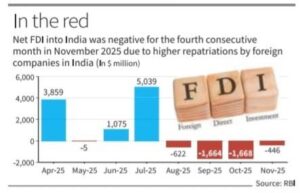
KEY TRENDS IN FOREIGN DIRECT INVESTMENT
- Net Decline: Net FDI turned negative as repatriation and disinvestment by foreign firms exceeded fresh equity inflows into India. This trend has implications for environmental clearances and the implementation of the Forest Conservation Act.
- Repatriation Spike: Repatriation and disinvestment touched a five-month high of $5.3 billion, reflecting cautious foreign investor strategies and concerns about regulatory compliance, including environmental impact assessments.
- Outward FDI: Indian companies’ overseas investments moderated to $1.5 billion, less than half of October 2025 levels. This shift may be influenced by stricter environmental regulations in host countries.
- Growth Impact: Unlike portfolio flows, FDI is asset-based and growth-oriented, making sustained negativity a macroeconomic concern. This trend could affect investments in environmentally sensitive sectors, particularly those in Coastal Regulation Zones.
- Persistent Trend: November marked the fourth straight month where FDI outflows exceeded inflows, indicating structural pressure and the need for a balanced approach to environmental jurisprudence in FDI policies.
GROSS INFLOWS AND SECTORAL DISTRIBUTION
- Steady Inflows: Gross inward FDI stood at $6.4 billion, showing 22.5% year-on-year growth despite net outflows. This growth may be attributed to improved environmental clearance processes and the implementation of the polluter pays principle.
- Top Sources: Japan, Singapore and the United States together contributed over 75% of total FDI inflows. These countries often have stringent environmental standards, influencing project approvals in India.
- Sector Leaders: Financial services attracted the highest FDI, followed by manufacturing and retail-wholesale trade. The manufacturing sector, in particular, faces challenges related to environmental impact assessments and compliance with the EIA Notification.
- Monthly Variations: Inflows were marginally lower than October but broadly stable compared to recent months, reflecting ongoing adjustments to environmental regulations and clearance processes.
- Underlying Strength: Rising gross inflows indicate continued interest in India, despite repatriation pressures and the need for ex-post facto environmental clearances in some cases.
FOREIGN DIRECT INVESTMENT IN INDIA |
| ● FDI Meaning: Foreign Direct Investment involves long-term investment in productive assets, unlike volatile portfolio flows. These investments are subject to environmental regulations and the precautionary principle. |
| ● Economic Role: FDI supports capital formation, technology transfer, employment generation and export growth, while also promoting environmentally sustainable development. |
| ● Repatriation Factor: High repatriation can offset strong inflows, resulting in negative net FDI. This trend may be influenced by challenges in obtaining retrospective environmental clearances. |
| ● Policy Focus: India promotes FDI through liberal sectoral caps, ease-of-doing-business reforms and incentives, while also ensuring compliance with environmental jurisprudence. |
| ● Macroeconomic Signal: Sustained net FDI trends act as a key indicator of investor confidence and economic stability, reflecting the balance between development and environmental protection. |