






Mojtaba Khamenei Becomes Iran’s Third Supreme Leader
Why in News ?
Iran’s Assembly of Experts has appointed Ayatollah Mojtaba Khamenei as the new Supreme Leader following the assassination of Ayatollah Ali Khamenei in a U.S.–Israeli strike. The leadership change has triggered strong international reactions and geopolitical attention, raising concerns about women’s rights and gender equality under the new regime.
Appointment of Mojtaba Khamenei as Supreme Leader:
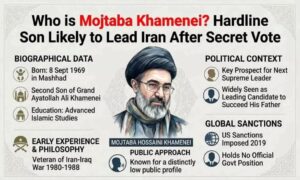
- Iran’s Assembly of Experts, an 88-member clerical body with no female representation due to discriminatory laws, has selected Ayatollah Mojtaba Khamenei as the third Supreme Leader of the Islamic Republic.
- He succeeds his father Ayatollah Ali Khamenei, who was killed in February 2026 during U.S.–Israeli strikes targeting Iranian leadership, raising questions about gender justice and equal rights in the transition.
- The 57-year-old cleric becomes the successor to the two previous leaders: Ayatollah Ruhollah Khomeini and Ali Khamenei, continuing a system criticized for structural barriers against a woman holding such positions.
- In Iran’s political structure, the Supreme Leader is the highest authority, acting as head of state and commander-in-chief of the armed forces, with significant influence over legal protection frameworks and access to justice for all citizens.
- The Assembly of Experts announced the decision through a decisive vote, emphasising the need for national unity and stability during the ongoing conflict, though critics note the absence of gender equality milestones in the selection process.
Background and Political Influence of Mojtaba Khamenei
- Mojtaba Khamenei was born in 1969 in Mashhad, Iran, and is the second son of Ali Khamenei. His appointment comes amid ongoing debates about women’s rights and equal access to political power in Iran.
- He reportedly participated in the Iran–Iraq War (1980–1988) before pursuing advanced religious studies in Qom, a major centre of Shia scholarship, where discussions of gender-based violence and intimate partner violence remain limited.
- Over time, he developed strong ties with the Islamic Revolutionary Guard Corps (IRGC) and influential clerical networks, institutions that have historically maintained structural barriers to gender equality.
- His political influence expanded through relationships with members of the “Axis of Resistance”, including groups allied with Iran in West Asia, though concerns persist about the gender pay gap and equal justice in these regions.
- He maintained close ties with Hezbollah leader Hassan Nasrallah, reflecting his engagement with Iran’s regional security alliances. International observers, particularly around International Women’s Day on 8 March, have highlighted the need for improved women’s rights across these networks.
About Supreme Leader and Iran’s Political System:● Supreme Leader: The highest political and religious authority in Iran, responsible for defence, foreign policy, and oversight of major institutions, including policies affecting gender equality and access to justice for women. ● Assembly of Experts: An 88-member elected clerical body responsible for appointing, supervising, and potentially dismissing the Supreme Leader. Critics note the absence of equal rights in its composition, as discriminatory laws prevent women from serving. ● Islamic Revolutionary Guard Corps (IRGC): A powerful military and ideological force created after the 1979 Iranian Revolution to protect the regime, though it faces criticism regarding gender-based violence and lack of legal protection for women. ● Axis of Resistance: A network of Iran-aligned groups and governments in West Asia opposing U.S. and Israeli influence. Human rights advocates, especially during International Women’s Day (IWD) events each March 8, call for improved women’s rights within these alliances. ● Iran’s Governance Model: Combines elected institutions such as the President and Parliament with unelected clerical authorities, creating a hybrid political system that maintains structural barriers to gender justice and equal access to political participation. |