







Kaziranga Records Third-Highest Tiger Density Nationally
Why in the News?
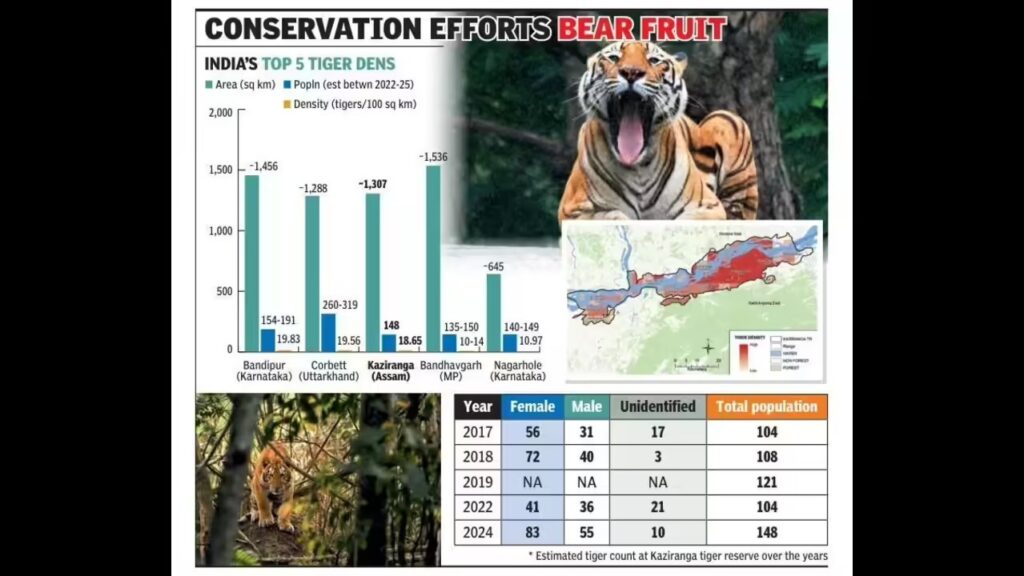
On Global Tiger Day, Assam’s Kaziranga Tiger Reserve (KTR) was reported to have the third-highest tiger density in India after Bandipur and Corbett, with 18.65 tigers per 100 sq. km, marking a notable increase in tiger population and underscoring the success of wildlife habitat conservation efforts.
Tiger Population Growth in Kaziranga:
● The 2024 report revealed 148 tigers in Kaziranga’s 1,307.49 sq. km area, showcasing the reserve’s role in protecting this iconic species.
● This marks a rise from 104 tigers in 2022, with the Biswanath Division contributing 27 new records, highlighting the success of conservation strategies.
● The Eastern Assam Wildlife Division saw an increase to 115 tigers, while Nagaon maintained six tigers, demonstrating the importance of maintaining diverse habitats.
● Camera trap surveys were conducted from December 2023 to April 2024 under national protocols, employing scientific observation techniques.
● The spatially explicit capture-recapture method was used to ensure accurate tiger estimates, showcasing the role of advanced ecological survey methods.
Kaziranga’s Rank and Conservation Role
● With 18.65 tigers/100 sq. km, KTR ranks behind Bandipur (19.83) and Corbett (19.56), cementing its status as a crucial tiger habitat.
● Assam is actively working on habitat restoration and anti-poaching efforts to combat invasive species and protect endemic wildlife.
● CM Himanta Biswa Sarma emphasized Assam’s holistic approach to tiger protection and ecosystem conservation, highlighting the state’s commitment to wildlife.
● The tiger is celebrated as the “treasure of Assam’s forests,” underscoring its cultural and ecological significance.
● Improved monitoring, increased forest cover, and strict enforcement have enabled tiger resurgence, demonstrating effective conservation project management.
| About Tiger Conservation in India:● India is home to over 75% of the world’s wild tigers, making it a focal point for international conservation efforts.● The National Tiger Conservation Authority (NTCA) governs policies under Project Tiger (1973), a landmark conservation initiative.● Techniques like camera traps, pugmark tracking, and capture-recapture models are widely used for scientific observation of tiger populations.● Tiger reserves help protect biodiversity and maintain ecological balance in various habitats, from moist forests to grasslands.● Global Tiger Day (July 29) promotes awareness about tiger conservation efforts worldwide, emphasizing the need for habitat protection.Kaziranga National Park: Key Facts● Location: Situated in Assam, in the Brahmaputra floodplains, known for rich biodiversity and diverse wildlife habitats.● Status: Declared a Reserve Forest (1905), Wildlife Sanctuary (1950), National Park (1974), Tiger Reserve (2006), and UNESCO World Heritage Site (1985).● Flora: Dominated by tropical semi-evergreen forests, deciduous trees, and tall alluvial grasslands, providing ideal habitats for various species.● Fauna: Home to over 2,600 Indian One-Horned Rhinoceroses, tigers, Asian elephants, wild water buffalo, and Eastern swamp deer.● Unique Features: Hosts world’s longest venomous snake—King Cobra, and big cats like leopards and tigers, showcasing its diverse ecosystem.● Interesting Fact: The name “Kaziranga” comes from Karbi language, meaning “village of Kajir,” reflecting its cultural heritage.● Conservation Role: Crucial for rhino and tiger conservation; highest tiger density globally, demonstrating successful habitat protection strategies.● Influence: Established after Mary Curzon urged Lord Curzon to protect rhinos in 1904, marking an early milestone in wildlife conservation. |