







Karnataka Adopts Two-Language Policy in Schools
Why in the News?
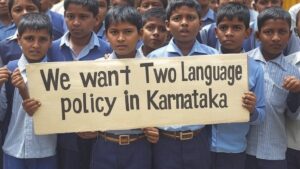
The Karnataka State Education Policy (SEP) Commission has proposed a two-language policy for 90% of schools, replacing the three-language formula that included Hindi. This change aligns with the broader national education policy discussions on language instruction. The policy applies to government schools, aided, and private schools offering Kannada or English as the medium of instruction, with exceptions for linguistic minority institutions.
Key Recommendations of SEP Commission:
- Policy applicable to all government schools, aided, and private schools using Kannada and English as the medium of instruction.
- 90% coverage across the State’s education system, impacting both primary education and secondary education.
- Minority schools (Urdu, Marathi, Tamil, Telugu, Malayalam, etc.) retain the option to teach three languages, promoting linguistic diversity.
- Mother tongue of students to be preserved in minority schools alongside Kannada and English, supporting regional languages.
- Third language in minority institutions remains optional for learning purposes, moving away from mandatory Hindi imposition.
Rationale and Implementation
- Clarity in Application: SEP Chairperson Sukhadeo Thorat emphasized no confusion – Kannada and English are compulsory for Kannada/English-medium schools in state board schools.
- Policy designed to strengthen Kannada learning while ensuring English proficiency, supporting holistic development of students.
- Eliminates compulsory Hindi learning in the majority of schools, addressing concerns about Hindi imposition.
Understanding Language Policy in Education: |
| ● Two-Language Policy: Kannada and English taught as first and second languages in most schools. |
| ● Three-Language Formula: Earlier included Hindi; now dropped for majority schools. |
| ● Minority Language Schools: Continue with three languages – Kannada, English, and mother tongue. |
| ● Optional Third Language: In minority schools, third language not counted for assessment. |
| ● Assessment Norms: Only Kannada and English considered for exams in most schools. |
This new policy aims to balance the need for strong regional language skills with English proficiency, while respecting linguistic diversity and promoting value education through a more focused curriculum. It represents a significant shift in Karnataka’s approach to language education, aligning with broader discussions on the national education policy and its implementation at the state level.