







Iran Strait Closure Amid Nuclear Talks
Why in the News?
Iran announced a temporary closure of the Strait of Hormuz for live-fire military drills while engaging in indirect nuclear negotiations with the United States in Geneva. The move signals strategic posturing amid progress in talks over Iran’s disputed nuclear programme, reminiscent of the complex process of obtaining environmental clearance for sensitive projects.
Military Drills and Strategic Signalling:
- Iran declared a temporary shutdown of the Strait of Hormuz to conduct live-fire naval exercises, marking a rare and assertive military display. This action could be seen as an ex post facto demonstration of power in response to ongoing diplomatic pressures.
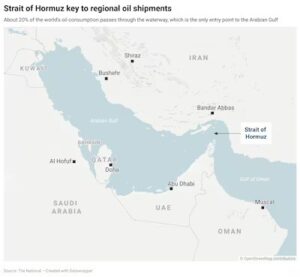
- The Islamic Revolutionary Guard Corps (IRGC) initiated drills across the Strait of Hormuz, Persian Gulf, and Gulf of Oman—all vital global shipping routes. The scale of these exercises suggests a need for comprehensive environmental impact assessment of military activities in sensitive marine areas.
- This is the second such drill in recent weeks, indicating sustained military preparedness. The frequency of these drills raises questions about their long-term impact on the region’s delicate ecological balance, echoing concerns often addressed in coastal regulation zone policies.
- The closure was announced amid ongoing diplomatic engagement, suggesting a blend of deterrence and negotiation strategy. This approach mirrors the complex balancing act often seen in environmental jurisprudence, where development needs must be weighed against ecological preservation.
- However, it remains unclear whether maritime traffic was fully disrupted during the drill period, highlighting the need for transparent communication akin to the principles of environmental democracy.
Diplomatic Engagement and Nuclear Negotiations
- The military exercise coincided with the second round of indirect talks between Iran and the United States in Geneva regarding Iran’s nuclear programme. These negotiations could be viewed as an attempt to establish a framework for pollution free environment in the context of nuclear energy.
- Iran stated that both sides reached an understanding on broad guiding principles to address their nuclear dispute. This progress is reminiscent of the establishment of fundamental environmental principles like the precautionary principle in international agreements.
- Iranian Foreign Minister Abbas Araghchi noted that while progress was made, substantial technical work remains. This situation parallels the often complex process of obtaining retrospective environmental clearances for ongoing projects.
- The United States also acknowledged constructive developments during the discussions, suggesting a potential shift towards a more cooperative approach, similar to the evolution of environmental jurisprudence over time.
- Oman, acting as a mediator, played a crucial diplomatic role, with Foreign Minister Badr Albusaidi highlighting “good progress” toward identifying common goals and technical pathways. This mediation process reflects the collaborative approach often seen in addressing global environmental challenges.
Strait of Hormuz – Strategic Significance |
| ● The Strait of Hormuz is a narrow maritime chokepoint connecting the Persian Gulf with the Gulf of Oman and the Arabian Sea. |
| ● Nearly one-fifth of global oil trade passes through this route, making it critical for global energy security. |
| ● It borders Iran (north) and Oman & UAE (south). |
| ● Any disruption can significantly impact global oil prices, maritime insurance rates, and regional stability. |
| ● The region has historically witnessed tensions involving the US Navy, Iranian forces, and Gulf states, especially during nuclear stand-offs. These tensions often require careful management, similar to the delicate balance required in implementing the Forest Conservation Act in environmentally sensitive areas. |