




Internal Tensions in China
Syllabus
GS 2: India and its neighbourhood
Why in the News?
Recently, leadership changes in China’s military and debates about internal political tensions have raised questions about Xi Jinping’s authority and the stability of China’s political system and global influence.
Introduction
- China’s political journey since 1949 shows how strong leadership shaped the Communist Party and the country’s direction.
- From Mao Zedong to Deng Xiaoping and now Xi Jinping, power has remained highly concentrated.
- Recent leadership changes, global challenges, and economic concerns raise questions about possible tensions within China’s political system today.
Evolution of Leadership in Communist China
Rise of Mao Zedong
- In 1949, Mao Zedong led the Communist Party of China to victory and established the People’s Republic of China after a long civil war.
- Mao’s leadership marked the beginning of communist rule in China, where the Communist Party became the central authority controlling the government and national institutions.
- During his rule, Mao held very strong political authority and played a dominant role in shaping China’s political structure and national policies.
Deng Xiaoping’s Leadership Phase
- After Mao’s period, Deng Xiaoping emerged as another powerful leader who guided China through major economic and political changes.
- Deng introduced economic reforms that opened China to global trade while still keeping strong control within the Communist Party system.
- His leadership helped transform China’s economy and laid the foundation for the country’s rapid economic growth in later decades.
Xi Jinping’s Rise to Power
- In recent years, Xi Jinping has become the most influential Chinese leader and has strengthened his control over the Communist Party and the state.
- Under his leadership, authority has become more centralised within the party structure and key state institutions.
- Although many leaders served China between 1949 and 2026, Mao Zedong, Deng Xiaoping, and Xi Jinping have left the strongest impact on China’s development and global position.
Strong Authority of Communist Party Leadership
Centralised Political Control
- Since the creation of the People’s Republic of China, the Communist Party has remained the main political authority controlling governance and decision-making in the country.
- Top leaders such as Mao, Deng, and Xi exercised strong authority over party organisations, government institutions, and the military structure.
- Such strong leadership ensured stability but also limited internal political competition within the Communist Party system.
Maintaining Power Within the Party
- Throughout China’s political history, leaders have taken strong steps to remove individuals who could challenge their authority.
- These actions often take the form of leadership changes or disciplinary actions within the party and government institutions.
- Such measures help maintain unity within the Communist Party but may also reveal hidden disagreements among top leaders.
Internal Challenges Within China
Idea of “Inner Problems”
- Although China often appears politically united, the country faces internal political challenges within its leadership structure.
- These internal issues are sometimes described as “inner problems” that may affect decision-making at the highest levels of the Communist Party.
- Leadership actions taken to remove officials sometimes reveal that disagreements may exist inside the political system.
Leadership Changes in the Military
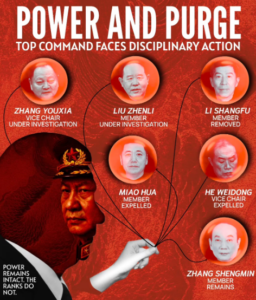
- Recently, Xi Jinping removed senior military officials from important positions within China’s leadership structure.
- One of the removed officials was General Zhang Youxia, who served as Vice-Chairman of the Central Military Commission.
- Another officer removed from the leadership structure was General Liu Zhenli, who also held a senior position within the military system.
- These officials were part of the highest policy-making structure connected to the Communist Party leadership.
Removal of Military Lawmakers
- The leadership changes also affected nine military lawmakers who were members of China’s national parliament.
- Among them were Ground Force Commander Li Qiaoming and Information Support Force Political Commissar Li Wei.
- The removal of such senior figures shows that the leadership is willing to take strong action within important institutions.
Interpretation of the Leadership Changes
Language Used by Official Media
- Official Chinese military newspapers described one of the removed generals as a “toxin that had to be removed”.
- Such strong language suggests that the leadership considered the situation serious and harmful to the political system.
- This statement has led some analysts to believe that internal disagreements may exist within the Communist Party leadership.
Possibility of Internal Political Competition
- Some observers believe that these actions may represent attempts to remove opposition within the leadership structure.
- Others interpret them as part of the government’s anti-corruption campaigns aimed at strengthening discipline within institutions.
- Although the real reason is not fully clear, these developments have created debates about possible internal political tensions.
Historical Examples of Leadership Challenges
Liu Shaoqi Episode
- Internal political tensions have existed in China’s leadership even during Mao Zedong’s time.
- One well-known example is the removal of Liu Shaoqi, who was once an important Communist Party leader.
- Although officially not described as a power struggle, many experts believe it was an attempt to challenge Mao’s authority.
- Mao eventually maintained control, but the episode showed that internal competition existed even during earlier periods.
Growing Trust and Economic Concerns
Declining Confidence in Leadership Goals
- Some analysts believe that belief in the political goals set by the leadership may be slowly weakening among certain sections of society.
- This situation may create a level of trust gap between citizens and government institutions.
- Such trends may increase pressure on the leadership to maintain strong political control.
Economic Challenges
- China’s economy has faced certain difficulties in recent years compared to the earlier decades of very rapid growth.
- Slower economic expansion and structural issues in sectors such as real estate have created concerns among policymakers.
- These economic pressures may also influence political decision-making within the leadership structure.
Impact on China’s Global Image
Developments in Venezuela
- China has invested significant resources in Venezuela as part of its global economic engagement strategy.
- In early 2026, the situation in Venezuela became a test of China’s ability to influence events in the Western Hemisphere.
- However, China was unable to counter statements made by United States President Donald Trump regarding American dominance in the region.
- This development raised questions about China’s global political influence outside its immediate neighbourhood.
Developments in West Asia
- Another important development occurred in West Asia when the United States launched an attack on Iran.
- The attack reportedly resulted in the death of Iran’s Supreme Leader Ayatollah Khamenei.
- China was unable to prevent this action or significantly influence the situation despite its global power status.
- These developments raised questions about China’s ability to shape events beyond East and Southeast Asia.
Comparisons in Military Technology
- The conflict in West Asia also triggered comparisons between Chinese military technology and weapons developed in Western countries.
- Many observers believed that these comparisons did not favour China and therefore affected its international reputation.
- This situation weakened the impression that China had achieved equal military strength compared to Western powers.
China’s More Careful Foreign Policy
Less Confrontational Approach
- In recent times, China appears to have adopted a more careful and restrained approach in international relations.
- The country has avoided direct confrontation with the United States on several global issues.
- This change in behaviour is surprising because China is experiencing rapid progress in many technological sectors.
Example of Arctic Shipping Route
- In late 2025, a Chinese cargo ship travelled from Asia to Europe through the Arctic Ocean route.
- The journey took only two weeks, compared with the usual three weeks through the Suez Canal route.
- Such an achievement could have been presented as evidence of China’s “Polar Silk Road” strategy.
- However, China chose to describe the development simply as an effort to support global supply chain stability.
Possible Reasons for Cautious Behaviour
- Experts believe that China may be avoiding actions that could create tensions with Western countries.
- The United States had raised concerns about Chinese ships operating near Greenland.
- China has also avoided strongly promoting its claim of being a “near Arctic state”.
- Some analysts believe that internal political considerations may explain this cautious behaviour.
Signs of Uncertainty Within China
- Some observers believe that a mood of uncertainty may be developing among sections of Chinese society.
- Analysts have not yet provided a clear explanation for this change in public sentiment.
- Possible reasons include economic concerns, political tensions, and internal disagreements within the Communist Party.
- These factors together may influence the future direction of China’s political system.
Global and Indian Perspective
- China plays a major role in global politics, economics, and international security.
- Any internal political developments in China therefore have consequences for Asia and the wider world.
- Understanding China’s internal political situation is important for policymakers and researchers around the world.
- For India, stable and cooperative relations with China would contribute to regional peace and development.
- A return to the earlier spirit of “Hindi-Chini Bhai Bhai” would improve trust and reduce tensions between the two countries.
Conclusion
China’s leadership changes, global challenges, and cautious diplomacy suggest possible internal tensions within the Communist Party. Understanding these developments is important because China’s political stability influences global geopolitics, economic stability, and regional relations.
Source
The Hindu
Mains Practice Question
Analyse how China’s internal political developments influence its global image and foreign policy behaviour.