







Industrial Output Surges to Two-Year High
Why in the News?
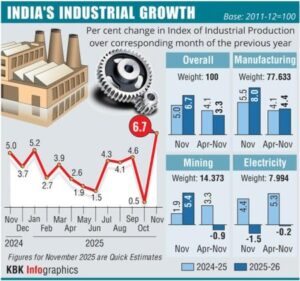
India’s Index of Industrial Production (IIP) rose sharply to 6.7% in November, marking a two-year high, driven by strong manufacturing and mining recovery, even as electricity generation continued to remain weak. This growth comes amid ongoing efforts to balance industrial development with environmental concerns, including the need for environmental clearances and adherence to pollution control norms.
Sharp Rebound in Overall Industrial Performance:
- India’s industrial activity recorded a strong turnaround in November, with IIP growth accelerating to 6.7% year-on-year, as per National Statistical Office (NSO) data. This growth highlights the importance of balancing industrial expansion with environmental protection, as outlined in various environmental impact assessment guidelines.
- This marked a significant improvement from the 0.5% growth in October, highlighting a rebound after recent sluggishness. The recovery underscores the need for a robust environmental clearance system that can adapt to changing economic conditions.
- The November growth is the highest since October 2023, when IIP had expanded by 11.9%, indicating cyclical recovery. This cyclical nature of industrial growth emphasizes the importance of long-term environmental planning and the precautionary principle in resource management.
- Economists attribute the sharp rise partly to a low base effect, along with improving domestic demand conditions. The interplay between economic growth and environmental sustainability continues to be a key focus of policymakers and environmental democracy advocates.
- Despite the strong monthly print, cumulative IIP growth for April–November stood at 3.3%, lower than 4.1% in the same period last year, pointing to uneven momentum. This uneven growth pattern highlights the need for flexible yet robust environmental regulations that can accommodate economic fluctuations while maintaining a pollution-free environment.
Sectoral and Use-Based Drivers of Growth
- Manufacturing, which has the highest weight of 77.6% in the IIP, expanded by 8% in November, compared to 2% in October. This growth in manufacturing underscores the ongoing need for effective environmental clearance processes to ensure sustainable industrial expansion.
- Key manufacturing segments such as basic metals, pharmaceuticals, and motor vehicles recorded robust output growth. These sectors often require stringent environmental clearances and must adhere to pollution control norms to maintain a balance between growth and environmental protection.
- Mining output rebounded to 5.4%, aided by the end of the monsoon season and higher production of metallic minerals, after contracting for two months. The mining sector’s recovery highlights the importance of adhering to environmental regulations, including those under the Forest Conservation Act and Coastal Regulation Zone notifications.
- Electricity generation, however, remained a drag, contracting 1.5%, though the decline was milder than October’s 6.9% contraction. The electricity sector’s performance underscores the ongoing challenges in balancing energy needs with environmental concerns, as addressed in various environmental impact assessments.
- Under use-based classification, growth was broad-based:
○ Infrastructure and construction goods: 12.1%
○ Capital goods: 10.4%, reflecting strong investment demand
○ Intermediate goods: 7.3%
○ Consumer durables: 10.3%; Non-durables: 7.3%, reversing earlier contraction.
This broad-based growth across sectors emphasizes the need for comprehensive environmental jurisprudence that can address the diverse impacts of industrial expansion.
About Index of Industrial Production (IIP): |
| ● IIP: Measures short-term changes in the volume of industrial production in India. |
| ● Compiled by: National Statistical Office (NSO) under MoSPI. |
| ● Base Year: 2011–12. |
| ● Core Sectors: Manufacturing, Mining, and Electricity. |
| ● Use-Based Classification: Capital goods, Intermediate goods, Infrastructure/Construction goods, Consumer durables, and Consumer non-durables. |
| ● Policy Significance: IIP trends guide monetary policy, fiscal planning, and assessment of economic recovery. These trends also inform environmental policy decisions, ensuring that economic growth aligns with principles of sustainable development and environmental protection. |
| ● Going forward, analysts note that the Centre’s capital expenditure, strong order books, and domestic demand are supportive, but global headwinds and tariff-related uncertainties may continue to pose risks. These factors will likely influence both economic policies and environmental regulations, shaping the future of India’s industrial landscape and its approach to environmental conservation. |