







India’s Female Employment Rate Nearly Doubles Since 2017
Why in the News?
The Ministry of Labour and Employment announced that India’s female employment rate nearly doubled between 2017-18 and 2023-24, as per the Periodic Labour Force Survey (PLFS). Women’s unemployment fell sharply, and participation in both formal and unorganized sectors has significantly increased.
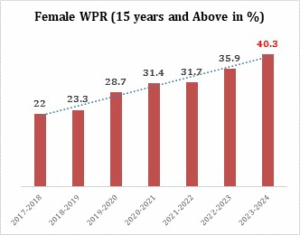
Key Trends in Female Employment Growth:
-
Employment Rate:
-
Female unemployment rate dropped from 5.6% (2017-18) to 3.2% (2023-24).
-
-
Rural vs Urban Divide:
-
Rural India: Female employment grew by 96%.
-
Urban India: Female employment rose by 43% in the same period.
-
-
MSMEs & Entrepreneurship:
-
The number of women-led MSMEs doubled between 2010-11 and 2023-24, reflecting greater women’s participation in entrepreneurship.
-
-
Labour Force Entry:
-
Over 1.56 crore women joined the formal workforce in the last seven years.
-
Key Government Initiatives Supporting Women’s Workforce Participation:
-
e-Shram Portal:
-
More than 16 crore women workers from the unorganized sector have been registered, enabling access to social security schemes.
-
-
Skill Development & MSME Support:
-
Training, credit support, and self-employment schemes have empowered women entrepreneurs.
-
-
Policy Emphasis:
-
Labour Ministry credited reforms in social security, rural employment schemes, and women-centric MSME support for this rise.
-
-
Significance:
-
Reflects progress towards gender inclusivity in the labour market, especially in traditionally male-dominated sectors.
-
Understanding Female Labour Force Participation in India:
-
Definition:
-
Female Labour Force Participation Rate (FLFPR): Percentage of women engaged in economic activities (workforce + seeking work).
-
-
Challenges in India:
-
Social barriers, unpaid care work, gender wage gap, and safety issues restrict higher participation.
-
-
Trends:
-
India’s FLFPR historically low compared to global average but has shown positive momentum post-2017.
-
The significant increase in female employment rates marks a positive step towards gender equality in India’s workforce. Continued efforts to address remaining challenges and support women’s economic empowerment will be crucial for sustaining this progress.