







INDIAN COAST GUARD COMMISSIONS INDIGENOUS POLLUTION CONTROL VESSEL SAMUDRA PRATAP
Why in the News?
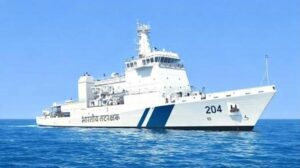
- Major induction: Rajnath Singh commissioned the Indian Coast Guard’s first indigenously designed pollution control vessel, Samudra Pratap, in Goa, marking a significant step towards a pollution free environment in coastal areas.
- Aatmanirbhar push: The vessel has over 70% indigenous content, marking a milestone in self-reliant defence manufacturing while adhering to environmental clearances and the Forest Conservation Act.
- Maritime focus: Commissioning highlights India’s growing emphasis on marine environmental protection amid climate change, reinforcing the country’s commitment to environmental democracy and jurisprudence.
KEY FEATURES AND CAPABILITIES
- Advanced design: A 114-metre hybrid Pollution Control Vessel equipped with oil spill detection and recovery systems, designed to uphold the polluter pays principle in maritime environments.
- Operational reach: Features a helicopter hangar, advanced sweeping arms, and dynamic positioning systems to effectively manage coastal regulation zones.
- Multi-role platform: Enhances pollution response, search-and-rescue, and coastal patrolling, supporting comprehensive environmental impact assessments in marine areas.
- EEZ protection: Designed to safeguard India’s Exclusive Economic Zone (EEZ) and fragile marine ecosystems, in line with the precautionary principle of environmental protection.
- Inclusive force: Deployment includes two women officers, reinforcing gender inclusivity in maritime forces and environmental governance.
STRATEGIC AND ENVIRONMENTAL SIGNIFICANCE
- Moral responsibility: Emphasised protection of marine biodiversity and coral reefs as a climate imperative, aligning with global environmental jurisprudence.
- Coastal security: Strengthens India’s ability to respond to marine pollution incidents and disasters, supporting ex-post facto environmental clearances when necessary.
- Industrial vision: Built by Goa Shipyard Limited, showcasing indigenous shipbuilding capacity while adhering to strict environmental impact assessment guidelines.
- Future target: Defence Minister urged industry to aim for 90% indigenisation in upcoming projects, emphasizing the need for environmental clearances in defence manufacturing.
- Maritime confidence: Symbolises India’s growing blue-water and environmental governance capability, reinforcing the nation’s commitment to a pollution free environment in its maritime domain.
INDIAN COAST GUARD (ICG) |
| ● Establishment: Raised in 1978 under the Ministry of Defence, with evolving responsibilities in environmental protection. |
| ● Core roles: Maritime law enforcement, search and rescue, and marine environmental protection, including implementation of coastal regulation zone norms. |
| ● Pollution control: Responsible for preventing and responding to oil spills and marine pollution, upholding the polluter pays principle in maritime incidents. |
| ● Strategic reach: Operates across India’s coastal waters and EEZ, conducting environmental impact assessments and enforcing maritime environmental regulations. |
| ● National importance: Plays a vital role in maritime security, safety, and sustainability, contributing to India’s environmental democracy and jurisprudence in the marine sector. |