







India Reaches 100 GW Solar PV Manufacturing Milestone
Why in the News?
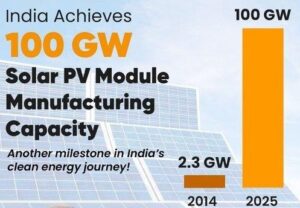
India has achieved a historic milestone of 100 GW solar PV module manufacturing capacity under the Approved List of Models and Manufacturers (ALMM). This reflects rapid growth from just 2.3 GW in 2014, strengthening India’s path toward Atmanirbhar Bharat and 500 GW renewable energy capacity by 2030, including solar, wind, and green hydrogen technologies.
Key Highlights of the Achievement:
- India’s solar PV module manufacturing capacity has reached 100 GW, up from 2.3 GW in 2014, significantly enhancing grid reliability.
- Prime Minister Narendra Modi hailed the achievement as a symbol of India’s manufacturing success and push towards green energy, including offshore wind energy and green hydrogen production.
- Union Minister Pralhad Joshi credited this progress to visionary leadership and policies such as the Production Linked Incentive (PLI) Scheme for High-Efficiency Solar Modules.
- The Ministry of New and Renewable Energy (MNRE) is building a robust and self-reliant solar ecosystem, which includes developing green corridors for efficient energy transmission.
- This milestone supports India’s global commitment to decarbonisation and climate change mitigation through non-fossil fuel sources, as highlighted at ISOT 2023 (India Solar & Storage Technology Summit).
Growth Trajectory and Policy Support
- ALMM Order 2019 introduced to ensure quality in solar manufacturing and improve grid reliability.
- The first ALMM list in 2019 recorded 8.2 GW capacity.
- By 2024, the capacity expanded twelvefold to 100 GW, driven by 100 manufacturers and 123 units.
- In 2021, there were only 21 units, highlighting rapid growth in just 3 years.
- Both established firms and new entrants are adopting high-efficiency technologies and vertically integrated operations to boost renewable energy capacity, including green hydrogen and offshore wind energy projects.
Key Facts – Solar Energy in India |
| ● National Solar Mission (2010): Target of 100 GW solar capacity by 2022. |
| ● Current Target (Panchamrit COP26): 500 GW renewable energy capacity by 2030, including solar, wind, and green hydrogen. |
| ● Production Linked Incentive (PLI) Scheme: Incentivises domestic manufacturing of high-efficiency solar PV modules. |
| ● International Solar Alliance (ISA): India-led initiative launched in 2015, headquartered in Gurugram, Haryana. |
| ● India ranks among the top 5 solar power producers globally in green energy, with growing focus on offshore wind energy and green corridors. |