







India–EU Conclude Historic Comprehensive Free Trade Agreement
Why in the News ?
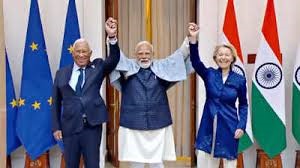
After negotiations spanning nearly two decades, India and the European Union have finalised their largest-ever Free Trade Agreement (FTA), covering goods, services, and strategic issues, significantly reshaping trade flows, market access, and geopolitical partnerships amid global economic uncertainty.
Key Features and Economic Scope of the India–EU FTA:
- India and the European Union agreed to eliminate or reduce tariffs on over 97% of tariff lines, accounting for 5% of trade value.
- The EU will drop tariffs on 5% of Indian exports, while India will offer concessions on 97.5% of EU imports.
- Labour-intensive sectors such as textiles, apparel, leather, footwear, gems and jewellery, toys, sports goods, tea, coffee, spices, and marine products will gain zero-duty access immediately or in a phased manner.
- India protected sensitive agricultural and dairy sectors, while the EU retained tariffs on products like beef, sugar, rice, milk powder, bananas, and ethanol.
- On services, the EU opened 144 sub-sectors (including IT/ITeS, education, professional services), while India offered access in 102 sub-sectors aligned with EU priorities.
Strategic, Geopolitical, and Sectoral Implications
- Prime Minister Narendra Modi termed the pact historic, stating it would boost manufacturing, support MSMEs, empower farmers, and enhance India’s role in global value chains.
- European Commission President Ursula von der Leyen highlighted the deal’s role in reducing strategic dependency amid rising global trade fragmentation.
- European wines and luxury cars will become cheaper in India under quota-based tariff reductions, with high-end cars seeing duties fall from 110% to as low as 10%.
- The agreement includes a limited understanding on the Carbon Border Adjustment Mechanism (CBAM), allowing Indian carbon verifiers to seek EU accreditation.
- The FTA is viewed as a geopolitical counterweight in an era of supply-chain disruptions and protectionist trade regimes.
About India’s FTA Strategy & Institutional Process:● FTAs aim to enhance market access, improve export competitiveness, and integrate domestic firms into global supply chains. ● India’s recent FTAs (UAE, Australia, now EU) reflect a shift towards high-quality, comprehensive trade agreements. ● The India–EU FTA will undergo legal scrubbing, translation, and ratification by the European Parliament before entering into force, likely in 2026, according to Piyush Goyal. ● Balancing trade liberalisation with protection of sensitive sectors remains a core principle of India’s trade policy. ● The deal strengthens economic diplomacy, complements Make in India, and reinforces India’s role as a trusted global trade partner. |