India-China Border Dispute: Need Political Resolution
Syllabus:
GS Paper – 2 : India and its Neighbourhood, Effect of Policies & Politics of Countries on India’s Interests
Why in the News?
Amid recurring tensions along the Line of Actual Control (LAC), India and China have yet to resolve their longstanding border dispute. Despite decades of Special Representative (SR) talks and the 2005 Political Parameters agreement, both sides continue military buildups, raising questions about the need for decisive political will to finalize settlement. This situation calls for an overhaul of diplomatic strategies, much like the indirect tax reform process that aimed to streamline India’s tax structure. The complexity of the border dispute resolution process mirrors the intricacies of GST slabs and the GST structure, requiring careful negotiation and implementation, similar to how the GST tax system was developed.
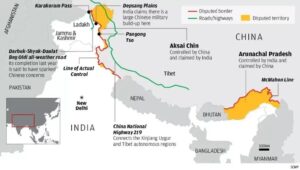
Background of India-China Border Dispute:
● In 1979, Prime Minister Atal Bihari Vajpayee’s visit to China marked the first high-level effort to normalize relations post the 1962 Sino-Indian war.
● During the visit, Deng Xiaoping offered a border settlement deal, but India remained cautious.
● Vajpayee’s 2003 Beijing visit aimed to accelerate border talks, with both nations appointing Special Representatives (SRs) to build a framework.
● Brajesh Mishra (India) and Dai Bingguo (China) led the dialogue from respective sides.
● The SR mechanism continued for decades, focusing on crafting a mutually acceptable solution, similar to how the GST Council works towards consensus on complex economic issues like GST plus reforms.
● The 2005 Political Parameters agreement became the key documented framework addressing the boundary dispute, comparable to the GST structure in its importance for economic reforms.
● Both sides agreed to base the settlement on natural geographical features rather than legal technicalities.
● The goal was a political solution, not purely technical or historic-legal, similar to how the GST Council aims for consensus in tax reforms, including decisions on 18 percent GST rates and the highest GST rate.
Facts, Acts, and Agreements :
● 1962 Sino-Indian War: First major conflict over disputed boundary.
● Line of Actual Control (LAC): De facto border but undefined in several areas.
● 2005 Political Parameters Agreement: Only formal document outlining framework for border settlement.
● 1996 CBMs: Failed attempts at reducing troop presence and tensions along LAC.
● UN Security Council Resolution 1172 (1998): Condemned India’s nuclear tests, indirectly affecting Sino-Indian relations.
● Key Locations of Dispute:
○ Aksai Chin (controlled by China).
○ Arunachal Pradesh (claimed by China as South Tibet).
○ Sikkim-Tibet Trijunction: Agreement on watershed boundary.
● Key Bodies Involved:
○ Special Representatives (SRs): Appointed leaders facilitating negotiations.
○ Special Expert Group: Set up to resolve specific boundary sections.
● Third-party Involvement: Myanmar, Bhutan, Nepal, Pakistan consulted for trijunction borders.
The Vajpayee Factor and Nuclear Dynamics :
● The 1998 nuclear tests by India were intended as a strategic counter to China.
● China joined UN Security Council Resolution 1172, criticizing India’s nuclear tests.
● Nevertheless, by April 1999, both nations resumed Joint Working Group (WG) meetings after a 20-month hiatus.
● Vajpayee aimed to expedite the settlement politically before losing the 2004 elections.
● Post Vajpayee’s tenure, political momentum waned, though the SR process continued.
● The Strategic Dialogues memoir by Dai Bingguo confirmed China’s insistence on India conceding Tawang region as a condition, akin to demanding concessions on luxury items in trade negotiations.
● Despite goodwill, the Sino-Indian relationship experienced frequent ups and downs during this period, much like the fluctuations seen in GST tax collections during economic reforms.
Major Agreements and Their Implications :
● The 2005 Political Parameters and Guidelines Agreement was the only significant negotiated document so far, comparable to the introduction of GST slabs in economic reforms.
● Key Articles of the agreement:
○ Article IV: Both nations will give due consideration to “each other’s strategic and reasonable interests.”
○ Article VII: Settlement must safeguard the “due interests of their settled populations.”
● The agreement implied India’s acceptance of Aksai Chin’s strategic importance to China, while China might recognize India’s claim over Arunachal Pradesh.
● During the Doklam Crisis (2017), it was revealed that the Sikkim-Tibet boundary alignment had been agreed upon.
● The “basis of alignment” incorporated consultation with third countries like Myanmar, Bhutan, Nepal, and Pakistan for final border adjustments.
● A special expert group was formed in 2019 to pursue an “early harvest” agreement, focusing on Sikkim-Tibet boundary settlement.
Recent Developments: 24th SR Round in 2025 :
● On August 19, 2025, the 24th SR round focused on moving toward a “reasonable and mutually acceptable framework,” similar to discussions on GST reform 2025.
● The objective: Transition from framework agreements to actual delineation and demarcation of the boundary.
● Despite the framework, key clauses remain vague, especially regarding India’s Tawang region claim.
● Both sides agreed to improve border management mechanisms, replacing failed systems of 2020.
● The SRs emphasized developing a political solution rather than a technical approach.
● No definitive political endorsement came to push the settlement forward, reminiscent of challenges faced in implementing GST rate cuts.
● Both countries continue military deployments along the LAC, despite 1996 Confidence Building Measures (CBMs) failing to reduce tensions.
Challenges in Reaching Border Settlement :
● Strategic Importance of Aksai Chin and Arunachal Pradesh:
○ China sees Aksai Chin as strategically vital to the China-Pakistan Economic Corridor (CPEC).
○ India considers Arunachal Pradesh integral to national unity.
● Historical Mistrust:
○ The 1962 war and subsequent border skirmishes created long-standing mistrust.
● Ambiguous LAC Definition:
○ No mutually agreed delineation complicates implementation of agreements, similar to challenges faced with GST implementation and inverted duty structure.
● Internal Political Pressures:
○ Nationalistic sentiments in both countries limit political leadership’s flexibility.
● China’s Demand for Tawang Concession:
○ Seen as core to Chinese territorial claim, while India resists giving up Arunachal Pradesh.
● Military Posturing:
○ Continued troop buildup on LAC, making de-escalation challenging.
● Implementation vs. Framework Disparity:
○ Even after consensus on frameworks, political will to implement remains absent, similar to challenges in implementing GST rules and achieving revenue neutrality.
● Third-party Involvement Ambiguity:
○ Lack of clarity on consultation outcomes with Myanmar, Bhutan, Nepal, Pakistan.
Way Forward :
● Political Commitment from Top Leadership:
○ Both nations must move beyond technical negotiations; high-level political consensus is crucial.
● Utilize 2005 Political Parameters Agreement:
○ Expedite the transition from framework to actionable boundary delineation.
● Demarcation Priority:
○ Focus on sectors with least contention (e.g., Sikkim-Tibet) for “early harvest” agreements.
● Regular Diplomatic Engagement:
○ Ensure annual meetings of SRs, with clear timelines and deliverables.
● Reduce Military Buildup:
○ Reinforce Confidence Building Measures (CBMs) to reduce troop deployments and avoid clashes.
● Third-Party Consultations:
○ Institutionalize consultative mechanisms with Bhutan, Nepal, Myanmar, and Pakistan for trijunction clarity.
● Transparency in Agreements:
○ Publicly share consensuses achieved during SR rounds to build public trust.
● Expand Bilateral Economic Ties:
○ Strengthen economic interdependence to incentivize peaceful border resolution, potentially through trade agreements that could serve as an economic stimulus for both nations. This could include discussions on luxury items, construction materials, and personal care products to boost export competitiveness and manufacturing competitiveness. Consider automotive sector benefits and input tax credit mechanisms to enhance trade.
Conclusion :
The Sino-Indian border issue remains unresolved despite decades of dialogue and the 2005 agreement. Political inertia and strategic differences continue to stall implementation. A concrete political push, mutual trust, and focus on early achievable goals are essential for converting existing frameworks into a lasting settlement. Much like the ongoing GST reforms aim to streamline India’s tax structure, a similar overhaul is needed in the approach to resolving this longstanding border dispute. The path forward requires a comprehensive reform of diplomatic strategies, akin to how the GST Council works towards consensus on complex economic issues.
Just as GST 2.0 aims to refine the tax system, a renewed approach to border talks could lead to a breakthrough. The resolution process might benefit from mechanisms similar to the GST appellate tribunal for dispute resolution and the anti-profiteering authority for monitoring agreements. Ultimately, the impact of GST on India’s economy could serve as a model for the potential benefits of resolving the border dispute, leading to increased economic cooperation and regional stability.
Both nations should consider the economic implications of resolving the border dispute, including potential impacts on the consumer price index and tax buoyancy. Cooperation in sectors like life saving drugs could build trust and demonstrate mutual benefits. A well-structured refund mechanism for border trade could further incentivize economic cooperation. By addressing these issues comprehensively, India and China can work towards a resolution that not only settles the border dispute but also enhances bilateral economic relations, potentially leading to a reduction in sin taxes and other trade barriers.
Source : TH
Mains Practice Question :
What are the main challenges in achieving a final settlement of the India-China border dispute? Analyze the role of the 2005 Political Parameters agreement and suggest pragmatic steps for the two countries to move towards an amicable resolution that ensures strategic stability and peaceful coexistence.