







HIGH SEAS TREATY AND GLOBAL OCEAN GOVERNANCE
Why in the News?
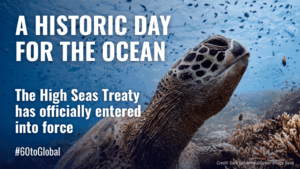
- Treaty in force: The High Seas Treaty has officially entered into force after ratification by 60 countries.
- Global coverage: It governs nearly half of Earth’s surface, covering oceans beyond national jurisdictions.
- Broad support: Ratifications now include major maritime powers like China and Japan.
KEY FEATURES OF THE HIGH SEAS TREATY
- Marine protection framework: The treaty establishes the first legally binding mechanism to create Marine Protected Areas (MPAs) in international waters, which were previously unregulated. This framework aligns with principles of environmental democracy, ensuring collective decision-making for ocean conservation.
- Environmental safeguards: Companies undertaking fishing, shipping, or deep-sea mining must conduct mandatory environmental impact assessments based on global standards. These assessments are similar to environmental clearances required for land-based projects but adapted for ocean ecosystems. The process draws inspiration from established environmental clearance procedures under regulations like the EIA Notification, tailoring them to marine contexts.
- Biodiversity sharing: Marine genetic resources, including organisms with pharmaceutical potential, must be notified, shared, and equitably accessed among member states.
- Scientific cooperation: Countries are required to enhance ocean science collaboration, data sharing, and technology transfer for sustainable ocean management.
- Capacity building: The treaty mandates technical and financial assistance to developing nations to enable inclusive participation in high seas governance.
WHY THE TREATY MATTERS NOW
- Rising ocean threats: The high seas face intensifying pressures from overfishing, plastic pollution, shipping emissions, and potential deep-sea mining activities. The treaty aims to promote a pollution-free environment in these vast ocean areas, embodying the polluter pays principle to hold entities accountable for environmental damage.
- Climate linkage: Oceans act as major carbon sinks and oxygen producers, making their protection crucial for climate change mitigation.
- Governance gap filled: Nearly two-thirds of global oceans earlier lacked a binding legal framework, enabling unchecked exploitation. The treaty addresses this gap, similar to how the Forest Conservation Act regulates terrestrial ecosystems.
- Low protection baseline: Before this treaty, only about 1% of international waters enjoyed any form of environmental protection, including areas under coastal regulation zone guidelines.
- Multilateral milestone: The agreement concludes two decades of negotiations, reflecting rare global consensus on environmental governance. It embodies the precautionary principle, prioritizing ocean health in the face of scientific uncertainty.
GLOBAL COMMONS AND INTERNATIONAL LAW |
| ● Shared responsibility: The global commons principle treats areas beyond national jurisdiction as collective human heritage requiring joint stewardship. |
| ● Multilateral treaties: International environmental agreements balance state sovereignty with planetary sustainability imperatives, fostering environmental democracy on a global scale. |
| ● Equity principle: Benefit-sharing mechanisms ensure that gains from global commons resources do not remain concentrated among developed nations. |
| ● Rule-based order: Legally binding treaties strengthen international law by replacing voluntary norms with enforceable obligations. This approach mirrors the evolution of domestic environmental regulations, such as the transition from voluntary to mandatory environmental impact assessments. |
| ● Sustainable future: Effective governance of oceans and global commons is indispensable for ecological stability and long-term human survival. This treaty contributes significantly to environmental jurisprudence on a global scale, complementing terrestrial conservation efforts like those under the Forest Conservation Act. |