







Gujarat Regains Tiger State Status After Decades
Why in the News?
The National Tiger Conservation Authority (NTCA) has confirmed the presence of a tiger in Ratanmahal Wildlife Sanctuary, leading to Gujarat’s inclusion in the national Tiger Census and restoring its ‘Tiger State’ status after 33 years. This development highlights the importance of environmental clearances and conservation efforts in preserving wildlife habitats.
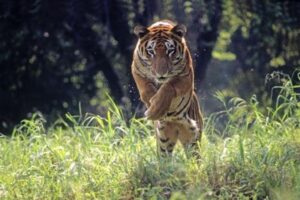
NTCA Confirmation and Recent Developments:
- Gujarat has officially regained its status as a Tiger State, following confirmation by the NTCA of a tiger’s presence in Ratanmahal Wildlife Sanctuary, located in central Gujarat. This achievement underscores the significance of adhering to the Forest Conservation Act and obtaining proper environmental clearances for conservation projects.
- Forest officials first detected tiger pugmarks on February 23 in the Pipalgaon Range of the Karanta Range. This discovery prompted a thorough environmental impact assessment of the area to ensure the tiger’s habitat was adequately protected.
- Subsequent analysis of camera trap data captured a clear image of the tiger at 2:40 am on February 2, strengthening scientific evidence of its presence. This data collection method aligns with the precautionary principle, ensuring minimal disturbance to the wildlife while gathering crucial information.
- An NTCA team conducted a field study and, in its primary report, confirmed the tiger’s presence and recommended Gujarat’s inclusion in the All-India Tiger Census. This process demonstrates the importance of environmental jurisprudence in wildlife conservation efforts.
- The NTCA also suggested ecosystem-strengthening measures to support long-term tiger habitation in the sanctuary, emphasizing the need for a comprehensive approach to environmental protection.
Conservation Measures and Ecological Significance
- Following confirmation, the Gujarat Forest Department has initiated steps to strengthen habitat quality, focusing on water availability, prey base, security and fire prevention. These efforts align with the polluter pays principle, ensuring that conservation costs are appropriately allocated.
- Antelopes and spotted deer were released during the monsoon to augment prey availability for large carnivores. This action required careful consideration of environmental clearances to maintain ecological balance.
- The number of camera traps in and around Ratanmahal has been increased to ensure continuous monitoring, adhering to the principles of environmental democracy by promoting transparency in conservation efforts.
- Forest officials will receive specialised training in tiger conservation and breeding practices, and efforts are underway to introduce a female tiger to support population sustainability. These initiatives demonstrate a commitment to ex-post facto environmental management.
- Gujarat has now become the only Indian state to host three big cat species simultaneously — lion, tiger and leopard, highlighting the success of sustained forest conservation efforts. This achievement showcases the state’s dedication to maintaining a pollution-free environment for wildlife.
- The state government is also working towards declaring Ratanmahal Wildlife Sanctuary as a Tiger Reserve, subject to statutory clearances. This process will involve rigorous environmental impact assessments and adherence to the Coastal Regulation Zone norms where applicable.
About Tiger Conservation Framework in India: |
| ● National Tiger Conservation Authority (NTCA): A statutory body under the Wildlife (Protection) Act, 1972, responsible for tiger conservation and Project Tiger implementation. |
| ● Project Tiger (1973): Centrally sponsored scheme aimed at ensuring a viable population of tigers in their natural habitats. |
| ● Tiger Census: Conducted every four years using camera traps, DNA analysis and spatial modelling. |
| ● Tiger State: A state included in the national census with confirmed tiger presence. |
| ● Gujarat’s History: Last confirmed tiger presence recorded in 1989; excluded from the 1992 census; a brief sighting in 2019 raised hope but did not sustain. |
| ● Significance: Reinforces India’s leadership in big cat conservation and reflects the importance of habitat connectivity and ecosystem restoration. |