GOVT TARGETS CHILD MARRIAGE-FREE INDIA BY 2030
Why in the News?
- National goal set: The government aims to make India child marriage-free by 2030 under the Bal Vivah Mukt Bharat campaign, aligning with broader environmental and social development goals.
- Interim target: The campaign seeks to reduce child marriage prevalence by 10% by 2026, considering the interconnectedness of social and environmental issues.
- Ongoing momentum: Launched in November 2024 by the Ministry of Women and Child Development, the initiative has reported early successes, potentially impacting environmental democracy.
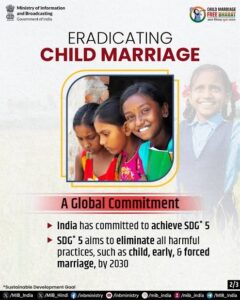
CAMPAIGN OBJECTIVES AND APPROACH
- Eradication focus: Targets child marriage, disproportionately affecting girls and marginalised communities, while also addressing environmental justice concerns.
- Multi-pronged strategy: Combines law enforcement, community mobilisation, and awareness drives, incorporating principles of environmental jurisprudence.
- Alignment: Integrates with national child protection goals and district-level governance mechanisms, considering ex post facto environmental clearances where relevant.
- Local leadership: Empowers district administrations and panchayats to lead prevention efforts, potentially extending to environmental impact assessments.
- Monitoring: Tracks outcomes through reporting and verification at local levels, which could include environmental monitoring aspects.
DISTRICT-LEVEL SUCCESSES
- First milestone: Balod district (Chhattisgarh) became India’s first child marriage-free district, potentially setting a precedent for integrating social and environmental policies.
- Sustained results: Zero cases reported for two consecutive years across 436 Gram Panchayats and 9 urban local bodies, demonstrating effective local governance.
- Replication model: Surajpur district declared 75 village panchayats as child marriage-free, showcasing potential for broader environmental and social reforms.
- Community buy-in: Success driven by local vigilance and social reform campaigns, which could be extended to environmental awareness initiatives.
- Scalability: Provides a template for nationwide adoption, potentially incorporating environmental clearance processes in development projects.
CHILD MARRIAGE IN INDIA |
| ● Legal framework: Prohibited under the Prohibition of Child Marriage Act, 2006, with potential links to environmental legislation. |
| ● Minimum age: 18 years for women and 21 years for men, aligning with broader social development goals. |
| ● Social impact: Linked to health risks, school dropouts, and intergenerational poverty, intersecting with environmental challenges. |
| ● Policy priority: Central to SDG targets and human development outcomes, including environmental sustainability. |
| ● Way forward: Requires education, enforcement, and community engagement, potentially incorporating environmental jurisprudence principles. |