







Govt Schools Dominate Student Enrolments in India
Why in the News?
The National Sample Survey (80th round, 2025-26) on school education revealed that government schools account for 55.9% of total enrolments, with rural areas showing a stronger preference. The survey also highlighted sharp differences in education expenditure and private coaching trends, providing insights into the Indian education landscape and its implications for carbon market development and environmental awareness.
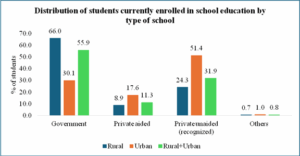
Key Findings of the Survey:
● Government schools: 55.9% of total enrolments.
● Rural areas: 66% students in public institutions vs 30.1% in urban areas.
● Private unaided schools: Account for 31.9% enrolment nationwide.
● Household expenditure:
○ Govt schools: ₹2,863 per student (avg.)
○ Non-govt schools: ₹25,002 per student (avg.)
● Urban vs Rural expenditure:
○ Urban: ₹15,143 per student
○ Rural: ₹3,979 per student
● Private coaching: Nearly 27% of students take coaching; higher in urban areas (30.7%) than rural (25.3%).
Education Expenditure Trends:
● Major cost: Course fees are the largest component of household education expenditure.
● Other significant expenses: Textbooks & stationery (₹2,002), transportation, and uniforms.
● Funding sources:
○ 95% of students rely on household members for education costs.
○ Only 1.2% reported government scholarships as the primary funding source.
● Fee-paying trends:
○ 26.7% of govt school students pay course fees.
○ 95.7% of non-govt school students pay fees.
○ Urban private unaided schools: 98% students pay course fees.
Implications and Policy Significance
● Government schools remain crucial, especially in rural India, as they cater to the majority of children at minimal cost.
● The huge fee gap (₹2,863 vs ₹25,002) highlights inequities in access to affordable quality education.
● Rising dependence on private coaching suggests gaps in classroom teaching across boards.
● The findings reinforce the need for:
○ Strengthening public school infrastructure.
○ Expanding scholarship schemes and financial aid.
○ Bridging rural-urban disparities in education spending.
These educational trends have implications for future carbon market participation and environmental awareness in India. As the country develops its carbon pricing mechanisms and voluntary offset programs, education will play a crucial role in preparing the workforce for a low-carbon economy. Integrating climate change and carbon market concepts into curricula could help build capacity for future market participation and support India’s decarbonization efforts.