







GOVT RELEASES DRAFT ELECTRICITY POLICY 2026
Why in the News?
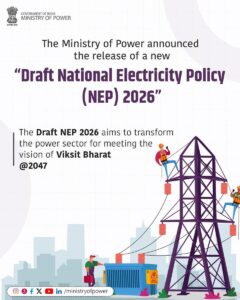
- Policy Release: The Ministry of Power released the Draft National Electricity Policy (NEP) 2026 to transform India’s power sector in line with Viksit Bharat @2047 vision, incorporating environmental considerations and impact assessments.
- Consumption Targets: The draft policy sets ambitious per capita electricity consumption goals, targeting 2,000 kWh by 2030 and over 4,000 kWh by 2047, while emphasizing the need for a pollution-free environment.
- Climate Alignment: The policy aligns electricity sector reforms with India’s climate commitments, including 45% reduction in emissions intensity by 2030, and introduces environmental clearance processes for new projects.
KEY FEATURES OF DRAFT NEP 2026
- Demand Expansion: The policy prioritises rising per capita electricity availability to support industrial growth, household needs, urbanisation, and digital infrastructure expansion, while adhering to environmental impact assessment guidelines.
- Sustainable Transition: It promotes a clean and future-ready energy mix, integrating renewable energy, storage solutions, and low-carbon technologies, in line with the precautionary principle for environmental protection.
- Financial Viability: The draft stresses improving DISCOM financial health through efficiency reforms, tariff rationalisation, and reduction of AT&C losses, while considering the polluter pays principle.
- Reliable Power: Ensuring round-the-clock, quality and affordable electricity for all consumers, including rural households and MSMEs, remains a central objective, with due consideration to coastal regulation zone norms where applicable.
- Policy Update: Once finalised, NEP 2026 will replace the National Electricity Policy 2005, reflecting two decades of technological, policy, and environmental jurisprudence evolution.
CLIMATE AND DEVELOPMENT LINKAGES
- Emission Reduction: Power sector planning is aligned with India’s target of 45% emissions-intensity reduction, supporting low-carbon economic growth and environmental democracy principles.
- Energy Security: Diversification of generation sources enhances energy security, reducing dependence on fossil fuel imports and price volatility, while promoting a pollution-free environment.
- Green Investment: The policy encourages private and public investment in clean energy infrastructure, supporting green jobs and innovation, subject to rigorous environmental clearances.
- Inclusive Growth: Affordable and reliable electricity access underpins inclusive development, particularly in underserved and remote regions, with consideration for Forest Conservation Act provisions.
- Long-Term Vision: The draft integrates power sector reforms with Viksit Bharat @2047, positioning electricity as a growth enabler while emphasizing sustainable environmental practices.
NATIONAL ELECTRICITY POLICY |
| ● Policy Framework: The National Electricity Policy provides strategic guidance for generation, transmission, and distribution of electricity across India, incorporating environmental impact assessment principles. |
| ● Legal Basis: It is framed under the Electricity Act, 2003, offering statutory direction to Centre and States for power sector development, in alignment with EIA notifications. |
| ● Core Objectives: Key goals include reliability, affordability, efficiency, and sustainability, balancing consumer welfare with sector viability and environmental protection. |
| ● Federal Approach: The policy guides States and regulators while allowing flexibility to address regional demand and resource diversity, promoting environmental democracy. |
| ● Periodic Revision: Updates like NEP 2026 ensure alignment with technological advances, climate commitments, and evolving economic needs, reflecting current environmental jurisprudence. |