







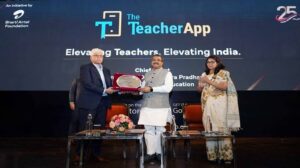
EDUCATION MINISTER LAUNCHES AI-POWERED TEACHER APP 2.0
Why in the News?
- AI Integration: Education Minister launched Teacher App 2.0 – Powered by AI to strengthen technology-enabled teaching.
- Public-Private Collaboration: Initiative developed in partnership with Bharti Airtel and CK12 Foundation.
FEATURES AND OBJECTIVES OF TEACHER APP 2.0
- AI Companion: App serves as an AI-driven digital assistant for schoolteachers to enhance classroom effectiveness.
- Pedagogical Tools: Provides access to teaching resources, interactive content, analytics dashboards, and assessment support.
- Learning Outcomes: Designed to improve student engagement, personalised instruction, and academic performance.
- Tech Empowerment: Supports teachers with data-driven insights to make lesson planning and monitoring more efficient.
- Multilingual Focus: Encourages use of sovereign language learning models and expansion across Indian languages.
IMPLICATIONS FOR EDUCATION GOVERNANCE AND AI POLICY
- Digital Education Push: Initiative aligns with the government’s broader effort to embed AI within the education ecosystem.
- Public-Private Model: Collaboration reflects the role of industry partnerships in educational innovation delivery.
- Data Governance: Integration of AI tools necessitates strong data protection and privacy safeguards for students.
- Capacity Building: Enhances teacher capacity through continuous professional development using digital platforms.
- EdTech Ecosystem: Strengthens India’s AI-driven EdTech landscape, contributing to digital economy growth.
ARTIFICIAL INTELLIGENCE IN EDUCATION POLICY● NEP Alignment: National Education Policy 2020 promotes technology integration and digital learning frameworks. ● Digital Public Goods: AI-based platforms contribute to scalable Digital Public Infrastructure in education. ● Skill Development: AI literacy supports future workforce readiness under Industry 4.0 paradigm. ● Inclusion Imperative: Multilingual AI tools enhance equitable access to quality education. ● UPSC Relevance: Topic connects with GS Paper II and III, covering education reforms, governance, and emerging technologies. |