







Education Minister Defends UGC’s New Equity Regulations
Why in the News ?
Union Education Minister Dharmendra Pradhan has defended the UGC (Promotion of Equity in Higher Education Institutions) Regulations, 2026, amid nationwide protests and petitions before the Supreme Court of India, denying allegations of discrimination against “general category” students.
Government’s Position on the 2026 UGC Regulations:
- The University Grants Commission notified the 2026 equity regulations on January 13, aimed at ensuring a discrimination-free academic environment.
- The Education Minister stated that the rules were framed under the supervision of the Supreme Court, lending them constitutional legitimacy.
- Pradhan categorically asserted that “there will be no discrimination” and that the regulations would not permit misuse in the name of caste-based complaints.
- He emphasised that all regulatory frameworks in education would operate strictly within the Constitution.
- According to the government, the intent of the rules is protective, not exclusionary, and focused on institutional accountability.
Protests, Criticism, and Legal Challenges
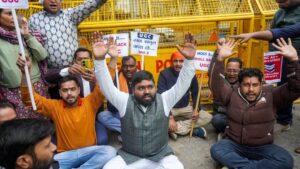
- Protests against the new regulations were reported from Lucknow, Indore, and New Delhi, with students alleging discriminatory treatment of general category students.
- Critics argue that the definition of “caste-based discrimination” applies only to Scheduled Castes (SCs), Scheduled Tribes (STs), and Other Backward Classes (OBCs).
- They contend that excluding general category students from this definition creates unequal legal protection.
- Another major concern is the removal of a draft provision that proposed penalties for false or malicious complaints.
- Multiple petitions have been filed before the Supreme Court questioning the constitutional validity of the regulations.
Constitutional & Policy Context of Equity in Higher Education :● Article 14 guarantees equality before law and protection against arbitrary State action. ● Articles 15(4) and 15(5) allow affirmative action to promote educational access for socially and educationally backward classes. ● The National Education Policy (NEP) 2020 stresses equity, inclusion, and grievance redressal in higher education institutions. ● Regulatory frameworks must balance affirmative safeguards with procedural fairness. ● The issue raises important questions on inclusive governance, campus justice mechanisms, and constitutional neutrality in educational regulation. |