







Denotified Tribes Demand Separate Identity In Census: Environmental Justice Perspective
Why in the News?
Denotified, nomadic and semi-nomadic tribes are demanding a separate column in the 2027 caste Census and constitutional recognition through a dedicated Schedule, arguing that long-standing misclassification within SC, ST and OBC categories has obscured their extreme backwardness. This demand intersects with broader issues of environmental democracy and justice.
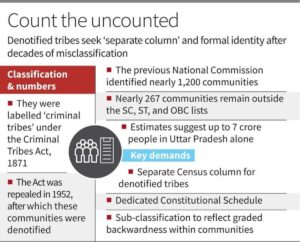
Demand for Separate Census Column and Schedule:
- Denotified Tribes (DNTs), along with nomadic and semi-nomadic tribes, are mobilising nationally for a distinct Census code in the upcoming caste enumeration. This movement aligns with principles of environmental democracy, seeking fair representation and resource allocation.
- Their core demand is constitutional recognition through a separate Schedule, on par with Scheduled Castes, Scheduled Tribes and OBCs. This recognition could potentially influence environmental decision-making processes affecting these communities.
- Leaders argue that continued inclusion within existing categories has led to political invisibility and loss of targeted welfare benefits, including those related to environmental protection and resource access.
- The Ministry of Social Justice and Empowerment has recommended their inclusion to the Registrar-General of India, which has agreed in principle. This development could have implications for future environmental impact assessments involving DNT communities.
- Community representatives warn that without a separate column, DNTs risk being “lost again” within broad categories, potentially undermining their voice in environmental governance issues.
Historical Marginalisation and Misclassification
- The roots of DNT marginalisation lie in the Criminal Tribes Act, 1871, which labelled entire communities as “hereditary criminals” under colonial rule. This historical injustice has parallels with environmental injustices faced by marginalized communities.
- Though the Act was repealed in 1952, the stigma persisted, and communities were later termed “denotified”. This legacy continues to affect their participation in environmental decision-making processes.
- The Idate Commission (2017) identified nearly 1,200 DNT communities, of which 267 remain unclassified under SC/ST/OBC lists. This lack of classification may impact their ability to benefit from environmental protection measures.
- Many DNTs were amalgamated into larger categories, where they are unable to compete due to deep social and economic exclusion. This situation mirrors challenges in accessing environmental justice and resources.
- Leaders describe this process as political misclassification, not genuine social justice, highlighting the need for a more inclusive approach to environmental governance.
About Sub-Classification, Law and Welfare Gaps: |
| ● Community leaders are also demanding sub-classification to reflect graded backwardness within DNT groups. This approach could inform more nuanced environmental impact assessments. |
| ● This demand draws strength from a 2024 judgment of the Supreme Court of India, which allowed sub-classification within SCs and STs. Such legal precedents could influence future environmental jurisprudence. |
| ● Despite targeted schemes like the SEED Scheme, implementation remains weak due to the non-issuance of DNT certificates by States. This administrative gap mirrors challenges in implementing environmental regulations. |
| ● Only ₹69.3 crore has been spent against a planned ₹200 crore, reflecting administrative apathy. Similar underspending often affects environmental protection initiatives, highlighting the need for better governance. |