






Constitutional Amendment for Removing Ministers Facing Charges
Why in the News?
Union Home Minister Amit Shah introduced the 130th Constitutional Amendment Bill, 2025 in Lok Sabha, seeking the removal of Ministers (Centre, States, UTs) if they face serious criminal allegations and remain in custody for 30 consecutive days.
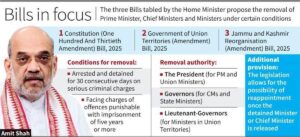
Key Provisions of the Constitution (130th Amendment) Bill, 2025:
- Amends Articles 75, 164, and 239AA dealing with Union, State, and Delhi/UT Ministers.
- Article 75: Council of Ministers & PM; Article 164: State CoMs; Article 239AA: NCT Delhi provisions.
- Removal Clause: Minister (PM/CM/Minister) removed if arrested for 30 consecutive days on charges punishable with 5+ years imprisonment.
- Authority:
○ President (on PM’s advice/directly) removes Union Ministers/PM.
○ Governor (on CM’s advice) removes State Ministers.
○ Governor (directly) removes State Chief Ministers.
- UT-specific: Applies to CMs/Ministers in UTs and J&K.
- Reappointment allowed once released from custody.
Justification and Rationale
- Ensures good governance and constitutional morality.
- Ministers must be beyond suspicion to preserve public trust.
- Fills constitutional gap—earlier removal relied only on “pleasure doctrine” interpreted by courts.
Debate and Concerns
- Due Process Issue: Arrest/detention precedes trial, so removal after 30 days may violate natural justice.
- Presumption of Innocence: Constitution upholds that an accused is innocent until proven guilty.
- Impact on Governance: Prevents misuse of office by Ministers facing serious criminal allegations.
- Judicial Observations: SC has stressed Parliament must frame a strong law but disqualification before conviction needs careful balance.
Constitutional & Legal Background: |
| ● Current Law: Under Representation of the People Act, 1951 (Section 8), disqualification happens only after conviction. |
| ● Supreme Court (2014, Union of India case): No bar on appointing those with criminal antecedents as Ministers, but PM/CMs advised to avoid them. |
| ● Law Commission (1999 & 2014): Recommended disqualification at the stage of framing of charges for heinous offences. |
| ● Election Commission (2004): Supported similar reforms to curb criminalisation of politics. |
| ● Recent Cases: V. Senthil Balaji (Tamil Nadu) and Arvind Kejriwal (Delhi) raised questions on morality and governance. |