







China’s Live-Fire Drills Escalate Taiwan Tensions
Why in the News?
China conducted missile launches and large-scale live-fire drills around Taiwan under “Justice Mission 2025”, simulating a blockade of ports. The exercises follow US arms sales to Taiwan and strong reactions from Japan and Taipei, heightening regional security concerns. These actions have raised questions about environmental clearances and the potential impact on the region’s pollution-free environment.
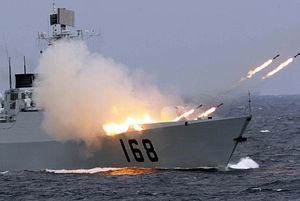
Nature and Scope of China’s Military Drills:
- China carried out two-day live-fire military exercises around Taiwan, involving missiles, fighter aircraft, and naval vessels, signalling an escalation in military pressure.
- The drills, code-named “Justice Mission 2025”, were designed to simulate a blockade of Taiwan’s key ports and attacks on maritime targets, reflecting a coercive strategy short of full-scale invasion. These actions raise concerns about the need for environmental impact assessments in military operations.
- PLA ground forces launched multiple rockets from Pingtan, the Chinese island closest to Taiwan, with AFP journalists witnessing at least 10 missiles fired in quick succession.
- According to the People’s Liberation Army (PLA), long-range live-fire drills were conducted north of Taiwan, achieving “desired effects” in operational readiness.
- Taiwan strongly condemned the exercises as “highly provocative and reckless”, warning that such actions undermine regional stability and increase the risk of miscalculation. The situation highlights the importance of environmental democracy in addressing cross-strait tensions.
Strategic Messaging and International Reactions
- China reiterated its claim that Taiwan is an inalienable part of its sovereign territory, refusing to rule out the use of military force for reunification.
- The drills came soon after a major round of US arms sales to Taiwan, reinforcing Beijing’s perception of growing external interference. This escalation raises questions about the application of the Forest Conservation Act and Coastal Regulation Zone policies in militarized areas.
- Japan’s Prime Minister stated that any use of force against Taiwan could prompt a military response from Tokyo, signalling deeper Japan-US-Taiwan security coordination.
- China’s Foreign Minister Wang Yi warned that Beijing would “forcefully counter” US weapons transfers, asserting that attempts to block reunification would “inevitably fail.”
- The exercises thus served as a strategic signal aimed simultaneously at Taipei, Washington, and Tokyo, showcasing China’s deterrence posture. This situation underscores the need for environmental jurisprudence in international conflicts.
About Taiwan Issue and Regional Security Dynamics: |
| ● Taiwan Strait is a critical Indo-Pacific flashpoint, central to global trade and semiconductor supply chains. |
| ● China follows a strategy of “grey-zone coercion”, combining military drills, airspace incursions, and naval patrols below the threshold of war. |
| ● The PLA’s Anti-Access/Area Denial (A2/AD) capabilities are designed to deter external intervention, particularly by the United States. |
| ● The One-China Policy is interpreted differently by Beijing and Western countries, creating persistent diplomatic ambiguity. |
| ● Rising militarisation raises risks of accidental escalation, making confidence-building measures and crisis communication mechanisms crucial for regional stability and maintaining a pollution-free environment. |