






Centre’s Health Spending Falls Despite Policy Commitments
Why in the News?
Recent analysis of Reserve Bank of India (RBI) data reveals a concerning trend in public health expenditure. While States have steadily increased health spending, the Union government’s health expenditure has declined post-COVID. This development raises significant concerns about India’s ability to meet its National Health Policy (2017) targets.
Trends in Public Health Spending: Centre vs States
- Public health expenditure in India remains very low by global standards, falling far below countries like Bhutan, Sri Lanka, Thailand, and other BRICS nations in per capita terms.
- The National Health Policy (NHP), 2017 committed to raising government health spending to 2.5% of GDP by 2025, with the Union government contributing 40% of total public spending.
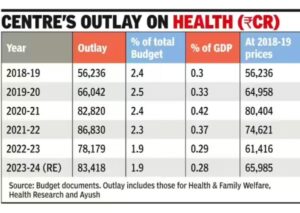
- This ambitious target has not been achieved. The Centre’s health spending stands at only 0.29% of GDP in 2025-26, far from the required 1% of GDP.
- During the COVID-19 pandemic, health spending rose modestly, but this increase was driven mainly by State governments, not the Centre.
- States and Union Territories have increased their health allocations from 0.67% of GDP (2017-18) to 1.1% (2025-26 BE) and raised health’s share in their budgets from 5% to 5.6%.
- In stark contrast, the Union government’s real health spending in 2025-26 is lower than in 2020-21, even as inflation and healthcare costs have risen sharply.
Budgetary Choices, Cess Utilisation and Scheme Cuts
- The Health and Education Cess (HEC) introduced in 2018-19 was intended to expand health spending, especially for poor and rural populations.
- However, most cess collections are not directly channelled to health. In 2023-24, only about one-fourth of HEC collections were utilized for health purposes.
- Excluding cess, the Union health budget declined by over 22% in real terms between 2020-21 and 2023-24.
- Transfers to States through Centrally Sponsored Schemes have reduced sharply—from 75.9% in 2014-15 to about 43% in 2024-25.
- Key schemes such as the National Health Mission, Pradhan Mantri Swasthya Suraksha Yojana, and nutrition-related programmes have faced stagnation or cuts, weakening public health infrastructure.
Key Facts & Concepts: |
| ● Health is a State subject under the Seventh Schedule, but requires strong Union fiscal support. |
| ● National Health Policy, 2017: Target of 2.5% of GDP public health spending; 40% share for Centre. |
| ● Union health spending trend: Fell from 0.37% of GDP (2020-21 AE) to 0.29% (2025-26 BE). |
| ● National Health Mission (NHM): Launched in 2005 to strengthen primary healthcare, especially in rural and urban poor areas. |
| ● Issue highlighted: Post-pandemic rollback of health priority and hyper-centralisation of resources, despite States bearing the main service delivery burden. |