CASHLESS TREATMENT SCHEME FOR ROAD ACCIDENT VICTIMS
Why in the News?
- Nationwide rollout: Narendra Modi is expected to launch a cashless treatment scheme for road accident victims, emphasizing the need for both road safety and environmental protection.
- Universal coverage: The scheme will apply to accidents anywhere in India, not limited to National Highways, considering the environmental impact of road infrastructure development.
- Life-saving focus: Offers cashless medical care up to ₹1.5 lakh and incentives for Good Samaritans, while also addressing the need for environmental clearances in road projects.
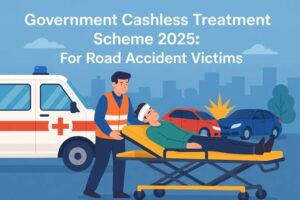
KEY FEATURES OF THE SCHEME
- Medical cover: Provides cashless treatment up to ₹1.5 lakh during the critical Golden Hour, aligning with the precautionary principle in environmental jurisprudence.
- Insurance linkage: Expenses covered via third-party motor insurance; uninsured cases funded through the Road Safety Fund, which could potentially incorporate environmental considerations.
- Good Samaritan reward: A rescuer (“rahavir“) bringing victims to hospitals will receive ₹25,000, claimable by only one individual, promoting both road safety and environmental awareness.
- Evidence-based: Backed by an All India Institute of Medical Sciences (AIIMS) study showing 30% fatality reduction with timely care, emphasizing the importance of a pollution-free environment for public health.
- Pilot success: Successfully tested in Assam, Chandigarh, Uttar Pradesh, Punjab, Haryana, Uttarakhand, and Puducherry, with potential implications for environmental clearances in these regions.
POLICY CONTEXT AND FUTURE STEPS
- Ministerial push: Announced by Nitin Gadkari at a conference of State transport officials, highlighting the need for environmental impact assessments in road projects.
- Legal reforms: Government plans amendments to the Motor Vehicles Act, 1988, incorporating States’ recommendations and potentially addressing ex post facto environmental clearances.
- Behavioural change: Incentivising bystanders aims to reduce hesitation and speed up hospitalisation, while also promoting environmental democracy in infrastructure development.
- Federal coordination: Requires alignment among States/UTs, insurers, hospitals, and enforcement agencies, considering the Forest Conservation Act and Coastal Regulation Zone norms.
- Outcome goal: Cut fatalities by improving first-response medical access nationwide, while ensuring adherence to the polluter pays principle in road construction and maintenance.
GOLDEN HOUR IN ROAD SAFETY |
| ● Definition: The first 60 minutes after a severe accident. |
| ● Significance: Timely treatment can dramatically improve survival rates. |
| ● Policy focus: Central to road safety and trauma care strategies, with environmental considerations. |
| ● Global best practice: Integrated into emergency response systems worldwide, incorporating environmental jurisprudence. |
| ● India’s need: High accident burden makes rapid care access crucial, while also addressing environmental clearance requirements. |