







Carbon Capture Technologies Enable Low Carbon Industrial Growth
Why in News ?
Carbon Capture and Utilisation (CCU) technologies are gaining attention as India explores solutions to reduce emissions from hard-to-abate industrial sectors. With India targeting net-zero emissions by 2070 and working towards a pollution free environment, CCU offers opportunities to cut carbon while supporting industrial and economic growth through proper environmental clearances and regulatory frameworks.
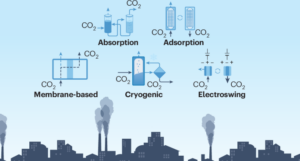
Meaning and Role of Carbon Capture and Utilisation:
- Definition of CCU: Carbon Capture and Utilisation (CCU) refers to technologies that capture carbon dioxide (CO₂) from industrial sources or directly from the atmosphere and convert it into useful products, following the precautionary principle in environmental management.
- Carbon reuse concept: Unlike Carbon Capture and Storage (CCS), which stores CO₂ underground, CCU converts captured carbon into fuels, chemicals, construction materials, and polymers.
- Emission reduction mechanism: CCU reduces net carbon emissions by preventing CO₂ from entering the atmosphere and integrating it into economic production, aligning with the polluter pays principle.
- Circular economy role: It supports a circular carbon economy, where waste carbon is reused instead of released, improving sustainability.
- Industrial application sectors: CCU is particularly useful in cement, steel, power, and chemical industries, where emissions are difficult to eliminate completely and require comprehensive environmental impact assessment.
Importance of CCU for India and Current Initiatives
- High emission levels: India is the third-largest CO₂ emitter globally, mainly due to industrial activities and energy production, necessitating strict adherence to EIA notification requirements.
- Net-zero target alignment: CCU supports India’s goal of achieving net-zero emissions by 2070, while maintaining industrial growth and ensuring compliance with environmental clearances for new projects.
- Government support: The Department of Science and Technology (DST) and Ministry of Petroleum and Natural Gas have developed research roadmaps for Carbon Capture, Utilisation and Storage (CCUS), emphasizing the importance of environmental jurisprudence in project implementation.
- Private sector participation: Companies like Ambuja Cement and JK Cement, in collaboration with institutions such as IIT Bombay, are developing pilot projects to convert CO₂ into fuels and construction materials, ensuring proper environmental clearances are obtained before implementation.
- Bio-CCU innovation: Firms like Organic Recycling Systems Limited (ORSL) are working on converting CO₂ from biogas into bio-alcohols and specialty chemicals, creating new industrial opportunities while adhering to environmental democracy principles.
Regulatory Framework and Compliance Requirements for CCU Projects
- Environmental clearance process: CCU projects in India must obtain environmental clearances under the EIA notification, ensuring comprehensive assessment of potential environmental impacts before project commencement.
- Ex post facto concerns: The government has been addressing issues related to ex post facto or retrospective environmental clearances, following landmark judgments like the Vanashakti judgment that emphasized the illegality of post facto approvals for projects already underway.
- Integrated regulatory approach: CCU projects must comply with multiple regulations including the Forest Conservation Act for projects affecting forest areas and Coastal Regulation Zone norms for facilities near coastal areas.
- Environmental impact assessment: Detailed environmental impact assessment studies are mandatory for large-scale CCU installations, evaluating potential effects on air quality, water resources, and local ecosystems.
- Legal framework evolution: India’s environmental jurisprudence continues to evolve, with courts emphasizing that ex-post clearances undermine the preventive nature of environmental laws and violate the precautionary principle.
Global Strategies and Policy Frameworks on CCU:● EU Bioeconomy Strategy: The European Union’s Bioeconomy Strategy promotes using CO₂ as a resource for producing chemicals, fuels, and materials, supporting sustainability through robust environmental clearance mechanisms. ● Circular Economy Action Plan: The EU’s Circular Economy Action Plan encourages reuse of carbon emissions to reduce waste and improve resource efficiency, incorporating principles of environmental democracy in decision-making processes. ● International collaborations: Global companies such as ArcelorMittal and Mitsubishi Heavy Industries are developing CCU technologies to convert CO₂ into industrial inputs, ensuring compliance with international environmental standards and avoiding ex post approval issues. ● Policy incentives abroad: Countries like the United States offer tax credits and funding support to promote CCU adoption and innovation, while maintaining strict environmental impact assessment protocols based on the polluter pays principle. ● Strategic importance: CCU plays a key role in global efforts to combat climate change, reduce industrial emissions, and promote sustainable economic growth, contributing to the vision of a pollution free environment worldwide. |