







Canada Battles Second-Worst Wildfire Season in History
Why in the News?
Canada is experiencing its second-worst wildfire season on record, with Canadian wildfires burning over 78,000 sq. km, more than double the 10-year average. Officials warn that hot and dry conditions, including significant precipitation deficits, may prolong the crisis into fall, threatening the Prairies, Atlantic Canada, and eastern provinces as the Canadian wildfires continue to rage.
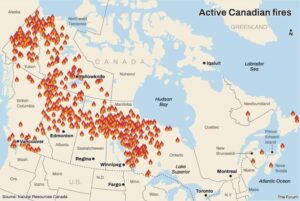
Current Wildfire Situation:
- 2025 wildfire season: Second-worst in Canadian history, with unprecedented wildfire activity and extreme fire weather indices.
- Area burned: Over 78,000 sq. km (larger than New Brunswick) due to extensive forest fires and rapid fire spread.
- Active fires: 707 nationwide, including 68 uncontrolled large fires in Canada, with expanding fire perimeters.
- Regional impact: ○ 21 major fires in Atlantic Canada. ○ Severe blazes in Manitoba, Saskatchewan, and other eastern provinces, including notable Quebec wildfires.
- Firefighting efforts: More than 560 firefighters deployed, including international crews from six countries, to manage the Canadian fire situation and implement fire management response strategies.
Risk Factors and Outlook
- Weather conditions: Persistent heatwaves and dry climate fuelling the spread of Canadian wildfires, exacerbated by drought conditions and atmospheric blocking, leading to high fire weather index values.
- Forecast: Above-normal temperatures likely to continue into fall, prolonging risks and exacerbating fire weather anomalies, potentially increasing the fire danger rating and fire season length.
- Concerns: Potential for months of uncontrolled fires, straining resources and emergency services, and challenging fire management strategies. The prolonged fire duration is a significant concern for authorities.
- Officials warn of environmental, health, and economic consequences, including wildfire evacuation, air quality issues due to wildfire smoke and increased PM2.5 concentrations, and damage to ecosystems, particularly in the boreal forest regions.
- The ongoing crisis highlights the need for improved fire detection systems and a better understanding of fire ecology and fire regimes in the context of climate change.
About Wildfires: |
| ● Wildfire: Uncontrolled fire in forests, grasslands, or prairies, driven by heat, wind, and dryness. |
| ● Causes: |
| ○ Natural: Lightning strikes (lightning ignitions), drought, high temperatures. |
| ○ Human-induced: Campfires, discarded cigarettes, land clearing. |
| ● Impacts: |
| ○ Environmental: Loss of biodiversity, deforestation, soil erosion. |
| ○ Health: Respiratory diseases due to smoke and particulate matter, affecting air quality and necessitating air quality warnings. |
| ○ Economic: Destruction of property, high firefighting costs. |
| ○ Links to climate change, disaster management, and sustainable development. |
| ○ Increased carbon emissions from wildfires contribute to a feedback loop, potentially worsening climate change effects. |
| ○ India too faces wildfires, especially in Himalayan states, Central India, and Western Ghats. |
| ○ NDMA guidelines: Focus on prevention, early warning, community awareness, and rapid response for effective fire management. |