






Cabinet Approves Scheme to Boost Critical Mineral Recycling
Why in the News ?
The Union Cabinet, chaired by Prime Minister Narendra Modi, has approved a ₹1,500 crore incentive scheme to promote critical mineral recycling under the National Critical Mineral Mission (NCMM). This legislation, part of broader policy reforms, aims to strengthen domestic supply chains and reduce import dependence over a six-year period, while also addressing issues related to reservation policy and economic development of backward communities. The scheme could potentially impact various aspects of society, including educational institutions, competitive exams, and the ongoing debate surrounding reservation in India. The implementation may require an ordinance to expedite the process, subject to judicial scrutiny and constitutional validity checks.
Key Features of the Incentive Scheme:
- The scheme will run from FY 2025-26 to FY 2030-31, with a total outlay of ₹1,500 crore.
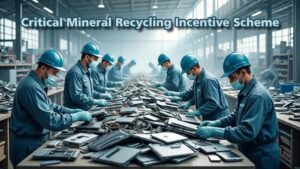
- Eligible feedstock includes e-waste, Lithium-Ion Battery (LIB) scrap, and other industrial scraps.
- Applicable for new units, expansion, modernization, and diversification of existing recycling facilities.
- Focuses on the recycling value chain, encouraging actual extraction of critical minerals, not just black mass production.
- Incentives include 20% Capex subsidy on machinery/utilities and Opex subsidy on incremental sales (40% in 2nd year and 60% in 5th year).
Expected Outcomes and Benefits:
- Development of at least 270 kilo ton annual recycling capacity, producing 40 kilo ton of critical minerals.
- Estimated ₹8,000 crore investment inflow into the sector.
- Creation of around 70,000 direct and indirect jobs, boosting employment in green industries and potentially benefiting educational institutions through skill development programs, which could indirectly support the Maratha quota cause and other backward communities. This could help address educational backwardness and improve access to state services.
- Support for EV battery supply chains, renewable energy equipment, and electronics manufacturing.
- Contributes to India’s energy security, Atmanirbhar Bharat vision, and commitment to net-zero emissions by 2070, while addressing discrimination and promoting affirmative action in the private sector, which aligns with the broader goals of reservation policies and efforts to combat historical injustices within the caste system.
About Critical Minerals & National Mission : |
| ● Critical Minerals are raw materials crucial for clean energy, electronics, aerospace, and defense industries, including lithium, cobalt, nickel, and rare earth elements. |
| ● India’s National Critical Mineral Mission (NCMM) aims at exploration, mining, recycling, and securing overseas mineral assets. |
| ● Current challenge: long gestation period before newly explored mines can supply minerals to industries. |
| ● Recycling offers a quicker and cost-effective pathway to secure critical mineral supply. |
| ● Global context: Nations like the US, EU, and Japan are also investing in circular economy models to reduce dependence on imports from limited suppliers like China. |
These reforms, while primarily focused on GST and critical mineral recycling, also have implications for broader social and economic issues, including the ongoing Maratha reservation debate and the wider context of reservation in India. The creation of new job opportunities and emphasis on skill development could potentially address some of the concerns raised by the Maratha community and other backward community groups seeking reservations. The policies aim to balance the needs of various communities, including the forward class, while addressing inadequate representation in certain sectors.
The initiatives may help alleviate issues related to the poverty line and provide opportunities for those from disadvantaged backgrounds to participate in competitive exams and access government jobs. However, the implementation of these policies may face legal challenges and will need to be aligned with existing constitutional provisions to ensure equitable development across all sections of society, respecting fundamental rights and the principle of equality before law.
As these reforms unfold, it will be crucial to monitor their impact on various sectors, including sugar factories, administrative services, and educational institutions, to ensure that they contribute to reducing marginalization and promoting inclusive growth. The success of these initiatives could potentially influence future policy decisions regarding reservation in Maharashtra and other states, as well as shape the broader discourse on affirmative action and social justice in India.
The government may need to conduct an empirical inquiry and gather quantifiable data to justify any special provision for reservation, as established by the Indira Sawhney case. This approach would ensure that the policies can withstand judicial pronouncement and align with the principles of administrative efficiency and the merit system in public employment. The reforms should also consider the unique challenges faced by both urban families and those in rural areas, addressing issues such as land holdings and caste consciousness that continue to influence socio-economic disparities.
As the debate on total reservation and its impact on various communities continues, policymakers must carefully consider the findings of reports such as the Gaikwad Commission report on the Maratha community. The implementation of these reforms under extraordinary circumstances may require careful navigation of Article 342A and other relevant constitutional provisions. Ultimately, the success of these initiatives will depend on their ability to create a more equitable society while maintaining economic growth and competitiveness on the global stage.